Toxic Backlinks Explained: Toxic backlinks are inbound links from spammy, manipulative, or low-quality websites that may negatively affect your website's SEO if they violate Google's spam policies or contribute to an unnatural backlink profile. While Google's algorithms have become much better at ignoring many spam links automatically, genuinely harmful backlinks can still lead to manual actions, reduce trust signals, and weaken your site's authority in certain situations. Knowing how to identify, evaluate, and manage these links is essential for maintaining a healthy backlink profile and protecting your organic search rankings.
If you've ever opened an SEO tool and discovered hundreds—or even thousands—of backlinks labeled as "toxic," you're not alone. It's one of the most common reasons website owners panic. The good news is that not every suspicious-looking backlink is dangerous, and blindly disavowing links can sometimes do more harm than good.
In this guide, you'll learn what toxic backlinks really are, how Google evaluates backlinks today, when you should actually worry, and the practical steps professionals use to keep their websites safe without making costly SEO mistakes.
What Are Toxic Backlinks? (Quick Answer)
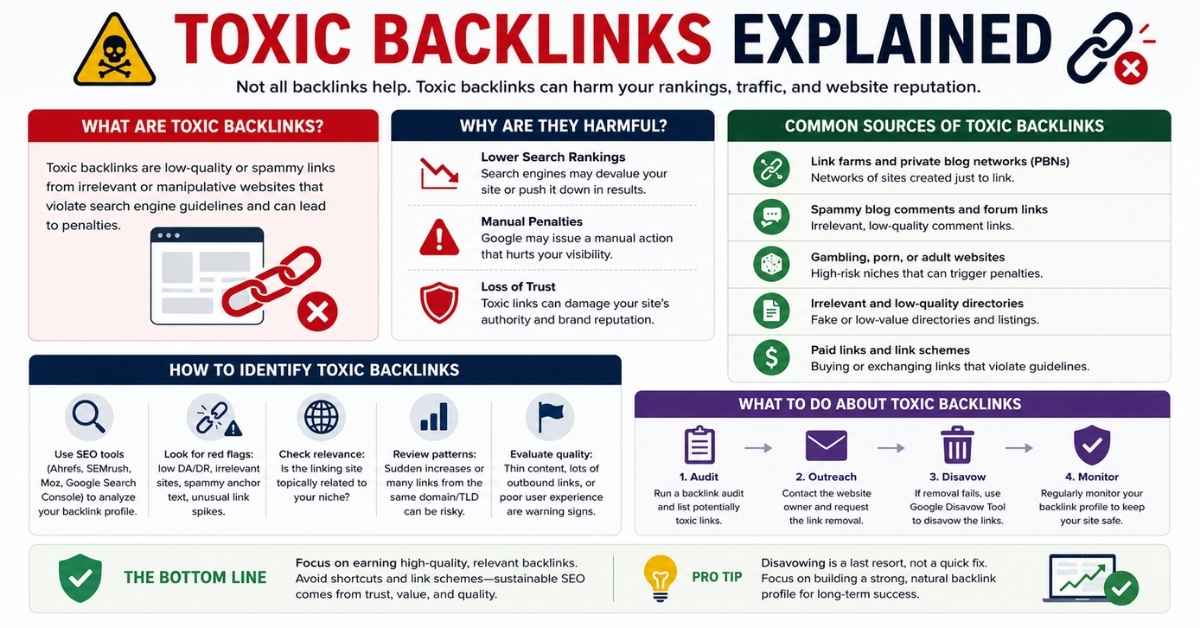
A toxic backlink is a link pointing to your website from a source that appears manipulative, deceptive, or created primarily to influence search rankings rather than provide value to users.
These links often originate from:
- Link farms
- Private Blog Networks (PBNs)
- Spam directories
- Hacked websites
- Automated blog comments
- Forum profile spam
- Low-quality article networks
- AI-generated spam websites
- Websites infected with malware
The purpose of these links is usually to manipulate Google Search rather than help users discover useful content.
Toxic Backlinks vs. Low-Quality Backlinks
Many people confuse low-quality backlinks with toxic backlinks, but they are not always the same.
| Backlink Type | Description | Risk Level |
| Editorial backlink | Earned naturally from a relevant, trusted website | Very Low |
| Low-quality backlink | Comes from a weak website but isn't manipulative | Low |
| Suspicious backlink | Looks unusual and deserves review | Medium |
| Toxic backlink | Violates Google's spam guidelines or is part of a link scheme | High |
For example, if a small personal blog links to your article because the author found it useful, the website may have low authority, but that doesn't automatically make the backlink toxic.
On the other hand, a backlink from a link farm built solely to manipulate rankings deserves closer attention.
Should You Panic If You Find Toxic Backlinks?
Usually, no.
Modern Google systems are designed to recognize and ignore many spammy links without penalizing your website. The real concern arises when your backlink profile contains large-scale manipulative links or when your site receives a manual action due to violating Google's spam policies.
The key is to evaluate links carefully instead of reacting to every "toxicity score" shown by SEO tools.
Do Toxic Backlinks Still Matter in 2026?
One of the biggest misconceptions in SEO is that every toxic backlink damages your rankings.
The reality is far more nuanced.
Google has invested heavily in advanced spam detection systems that can recognize many unnatural links without requiring website owners to take action. However, this doesn't mean backlinks no longer matter. Instead, Google focuses more on the overall quality, relevance, and trustworthiness of your backlink profile rather than isolated spam links.
Google's Current Approach to Spam Links
Today's search algorithms evaluate links differently than they did years ago.
Rather than counting every backlink equally, Google looks at:
- Topical relevance
- Editorial intent
- Website trust
- Authority signals
- Natural linking patterns
- Anchor text diversity
- Overall backlink quality
If Google determines that a backlink exists solely to manipulate rankings, it may simply ignore the link instead of allowing it to pass ranking value.
This approach helps reduce the impact of random spam links pointing to legitimate websites.
How Google's Spam Detection Has Changed
Years ago, many websites experienced ranking losses due to poor-quality backlinks. Since then, Google's spam detection systems have become much more sophisticated.
Modern systems analyze:
- Link context
- Website reputation
- Link placement
- User value
- Content quality
- Natural link growth
- Editorial signals
- Historical linking behavior
Instead of relying on simple metrics, Google now evaluates backlinks within a broader context, making it much harder for artificial link-building tactics to influence search results.
When Toxic Backlinks Can Still Hurt Rankings
Although Google ignores many spammy links, toxic backlinks can still become a problem in situations such as:
Participation in Link Schemes
Buying or exchanging links to manipulate rankings violates Google's spam policies.
Large-Scale Paid Links
Hundreds or thousands of paid backlinks created solely for SEO can trigger manual reviews.
Private Blog Networks (PBNs)
Using interconnected websites to artificially build authority remains a risky practice.
Hacked Website Links
Links injected into compromised websites can create trust issues.
Manual Actions
If Google's review team determines that your backlink profile intentionally manipulates search rankings, your website may receive a manual action, which can significantly reduce visibility until the issue is resolved.
Manual Actions vs. Algorithmic Ignoring
Understanding this distinction helps eliminate unnecessary fear.
| Manual Action | Algorithmic Ignoring |
| Issued by Google's review team | Performed automatically by Google's systems |
| Can significantly affect rankings | Often has little or no visible impact |
| Requires investigation and corrective action | Usually requires no action |
| Appears inside Google Search Console | No notification is provided |
Many website owners confuse these two situations and assume every spam backlink requires immediate removal, which isn't always true.
Expert Insight: A backlink labeled as "toxic" by an SEO tool isn't automatically harmful in Google's eyes. Third-party tools estimate risk using their own algorithms, while Google evaluates backlinks using far more sophisticated ranking systems.
How Google Evaluates Backlinks Today
Google doesn't simply count backlinks anymore. Instead, it evaluates whether each link genuinely helps users and whether it represents a natural editorial recommendation.
Think of backlinks as recommendations. A recommendation from a respected expert carries more weight than one from an unknown source created solely for promotion.
Here are the primary signals Google considers when evaluating backlinks.
Authority
A backlink from a well-established, trustworthy website generally carries more value than dozens of links from weak or spammy domains.
Authority isn't just about popularity—it's about credibility within a specific topic.
For example, a cybersecurity website linking to an article about online security is far more meaningful than an unrelated website with no expertise in that field.
Relevance
One of the strongest signals is topical relevance.
Google asks questions such as:
- Does this website cover the same subject?
- Is the linking page contextually related?
- Does the backlink naturally support the content?
A highly relevant backlink often provides more value than multiple unrelated backlinks.
Trust
Google evaluates whether the referring website appears trustworthy.
Trust signals include:
- Original content
- Editorial standards
- Transparent ownership
- Secure browsing
- Consistent publishing history
- Positive reputation
Websites known for spam, malware, or deceptive practices are far less likely to pass meaningful ranking value.
Editorial Intent
Natural backlinks are typically earned because someone genuinely found the content useful.
Examples include:
- Citing research
- Recommending a helpful guide
- Referencing statistics
- Supporting an argument
- Sharing valuable resources
Manipulative backlinks created only to influence rankings generally lack authentic editorial intent.
Link Placement
The position of a backlink also provides context.
Links naturally placed within the main body of relevant content usually carry stronger signals than links hidden in:
- Sidebars
- Footers
- Sitewide templates
- Spam comments
- Automatically generated pages
Google evaluates whether the placement appears useful for readers.
Anchor Text Context
Anchor text helps search engines understand the relationship between two pages.
Healthy backlink profiles contain a natural mix of:
- Branded anchors
- URL anchors
- Generic anchors
- Partial-match keywords
- Descriptive phrases
Overusing exact-match keywords can create an unnatural pattern that raises concerns.
Natural Link Patterns
Google expects backlinks to grow naturally over time.
Healthy websites usually receive links from:
- Different industries
- Various geographic locations
- Multiple referring domains
- Diverse content formats
- Editorial publications
- Blogs
- News websites
- Educational resources
A sudden surge of thousands of identical backlinks often signals artificial link-building.
User Value Signals
Ultimately, Google rewards backlinks that improve the user experience.
A valuable backlink should:
- Help readers discover relevant information
- Support the surrounding content
- Add context
- Improve credibility
- Guide users to additional useful resources
When backlinks exist solely to manipulate rankings, they provide little value to users—and Google has become increasingly effective at recognizing that difference.
Practical Example: Imagine two websites linking to your article about SEO. One is a respected digital marketing publication recommending your guide because it adds value for readers. The other is an unrelated website filled with spun content and dozens of outbound links. Although both are backlinks, only the first demonstrates authority, relevance, trust, and editorial intent—the qualities Google is most likely to reward.
What Makes a Backlink Toxic?
Not every backlink from a low-authority website is harmful. A toxic backlink becomes a concern when it's created to manipulate search rankings rather than provide value to users. Google looks beyond metrics like Domain Authority or Spam Score and evaluates the intent, relevance, and quality behind a link.
A backlink is more likely to be considered toxic if it:
- Comes from a website built solely for selling or exchanging links.
- Is part of a link scheme or Private Blog Network (PBN).
- Appears on a hacked or malware-infected website.
- Uses excessive exact-match anchor text unnaturally.
- Exists within automatically generated or AI-spun content.
- Has no contextual relevance to your topic.
- Is hidden in footers, sidebars, or widgets across hundreds of pages.
- Is created through automated software or spam bots.
The more unnatural signals a backlink has, the greater the likelihood it could become problematic—especially if your website intentionally participated in acquiring those links.
Characteristics of Harmful Links
Professional SEO specialists evaluate backlinks using multiple quality signals rather than relying on a single metric.
Some common characteristics include:
- Irrelevant content that has no connection to your niche.
- Excessive outbound links on a single page.
- Thin or duplicate content.
- Poor website design filled with advertisements.
- Recently expired domains repurposed for link building.
- Suspicious anchor text stuffed with commercial keywords.
- Pages that receive little or no organic traffic.
- Networks of websites linking heavily to one another.
Warning Signs to Look For
During a backlink audit, pay attention to these warning signs:
- Hundreds of new backlinks appearing overnight.
- Referring domains with random or nonsensical names.
- Links from websites in unrelated industries.
- Large numbers of backlinks using identical anchor text.
- Websites that have been deindexed by Google.
- Links hidden within invisible text or page footers.
- Pages created only to host outbound links.
One suspicious backlink isn't necessarily a problem, but repeated patterns deserve closer investigation.
High-Risk Link Sources
Certain backlink sources consistently raise red flags:
- Link farms
- Private Blog Networks (PBNs)
- Paid link marketplaces
- Spam directories
- Automated blog comments
- Forum profile spam
- Hacked websites
- Malware-infected domains
- AI-generated content farms
- Scraper websites
- Casino, adult, or pharmaceutical spam sites unrelated to your niche
Low-Risk Links That People Often Mistake as Toxic
Many website owners panic over links that are actually harmless.
Examples include:
- New blogs with low authority
- Foreign-language websites mentioning your content naturally
- Content aggregators
- RSS feed websites
- Small local businesses linking to your resource
- Brand mentions without commercial intent
These links may pass little SEO value, but they aren't automatically toxic.
Expert Tip: Focus on identifying patterns of manipulation, not isolated backlinks. A healthy backlink profile naturally contains a mix of strong, average, and weak links.
Common Types of Toxic Backlinks (With Real Examples)
Understanding the different types of harmful backlinks makes it easier to decide whether to ignore, remove, or disavow them.
Link Farms
A link farm is a network of websites created solely to exchange or sell backlinks.
Example: A website with hundreds of unrelated articles where every page links to dozens of businesses in different industries.
Risk: High
Private Blog Networks (PBNs)
A PBN is a collection of websites controlled by one owner to artificially pass authority.
Example: Ten expired domains all publishing thin SEO articles that repeatedly link to the same money site.
Risk: High
Paid Links That Pass Ranking Signals
Buying backlinks that are intended to manipulate search rankings violates Google's spam policies.
Example: Paying a website owner to insert a dofollow link into an unrelated article without proper disclosure.
Risk: High
Spam Directory Links
Years ago, submitting websites to hundreds of directories was a common SEO tactic. Today, most low-quality directories provide little value.
Example: A directory listing thousands of unrelated businesses with no editorial review.
Risk: Medium to High
Automated Comment Spam
Software-generated comments containing backlinks remain one of the oldest spam techniques.
Example:
"Great article! Visit my website for the best SEO services."
These comments provide no value to readers.
Risk: Medium
Forum Profile Spam
Creating fake user profiles solely to place backlinks is another outdated practice.
Example: Hundreds of empty forum accounts with identical profile links.
Risk: Medium
Hacked Website Links
Hackers sometimes inject hidden backlinks into compromised websites without the owner's knowledge.
Example: A university website unknowingly containing hidden outbound links to gambling websites.
Risk: High
Scraper Site Links
Scraper websites automatically copy content from legitimate websites.
Although these backlinks often look suspicious, Google generally recognizes them for what they are.
Risk: Usually Low
Irrelevant Foreign-Language Links
Many website owners worry when they see backlinks from websites written in another language.
If those links are natural mentions, they usually aren't harmful.
However, thousands of unrelated foreign-language spam pages linking to your website may deserve investigation.
Risk: Low to Medium
Widget and Footer Links
Sitewide footer or widget backlinks placed across hundreds of pages can create unnatural linking patterns.
Example: A free WordPress theme embedding keyword-rich backlinks in every installation.
Risk: Medium to High
AI-Generated Spam Networks
With the rise of generative AI, thousands of low-quality websites now publish mass-produced content primarily to manipulate search rankings.
Characteristics include:
- Thin articles
- No editorial oversight
- Keyword stuffing
- Duplicate information
- Thousands of outbound links
Not every AI-assisted website is spam, but large automated networks often display clear signs of manipulation.
Risk: High
Toxic vs. Suspicious vs. Harmless Backlinks
| Type | Characteristics | Recommended Action |
| Harmless | Natural, relevant, editorial | Keep |
| Suspicious | Low relevance or unusual pattern | Review manually |
| Toxic | Manipulative or spam-focused | Investigate, remove, or disavow if necessary |
Signs Your Website May Be Affected by Toxic Backlinks
A drop in rankings doesn't automatically mean toxic backlinks are responsible. Technical SEO issues, algorithm updates, poor content, or increased competition can produce similar symptoms.
Still, certain warning signs deserve investigation.
Ranking Drops
If important keywords suddenly lose visibility without major website changes, review your backlink profile alongside other SEO factors.
Organic Traffic Decline
A noticeable decline in organic traffic may indicate a broader SEO issue, especially if it coincides with suspicious backlink activity.
Manual Action Notifications
The clearest warning sign is receiving a manual action notification in Google Search Console for unnatural inbound links.
This requires immediate investigation.
Sudden Spike in Referring Domains
A website gaining thousands of backlinks overnight should be reviewed carefully.
Ask questions like:
- Where did these links originate?
- Are they relevant?
- Are they part of the same network?
Unnatural Anchor Text Patterns
If most backlinks use the exact same commercial keyword, your backlink profile may appear manipulated.
Healthy profiles include a natural mix of:
- Brand names
- URLs
- Generic phrases
- Partial-match anchors
- Descriptive anchor text
Spammy Referring Websites
Review referring domains for:
- Thin content
- Excessive advertisements
- Malware warnings
- Poor user experience
- No topical relevance
Reality Check: These symptoms don't automatically prove your backlinks are causing ranking issues. Always investigate technical SEO, content quality, Core Web Vitals, search intent alignment, and recent Google updates before blaming backlinks.
How to Identify Toxic Backlinks Step by Step
A professional backlink audit combines Google Search Console with trusted SEO tools and manual review.
Step 1: Review Google Search Console Data
Export your latest backlinks and referring domains.
Look for:
- New linking domains
- Unusual growth
- Manual actions
- Frequently linked pages
Step 2: Analyze Referring Domains
Evaluate each domain based on:
- Relevance
- Authority
- Reputation
- Organic visibility
- Content quality
Avoid judging a website using a single SEO metric.
Step 3: Evaluate Link Relevance
Ask yourself:
- Is this website related to my niche?
- Would a real reader click this link?
- Does the backlink make sense within the article?
Relevant links generally provide stronger trust signals.
Step 4: Check Anchor Text Distribution
A healthy anchor text profile usually contains:
- Branded anchors
- Naked URLs
- Generic anchors
- Partial-match keywords
- Natural descriptive phrases
Too many exact-match anchors can indicate manipulation.
Step 5: Review Traffic and Indexing Signals
Investigate whether the referring website:
- Receives organic traffic.
- Is indexed by Google.
- Publishes original content.
- Maintains editorial quality.
Step 6: Compare Findings Across SEO Tools
Different tools calculate backlink quality differently.
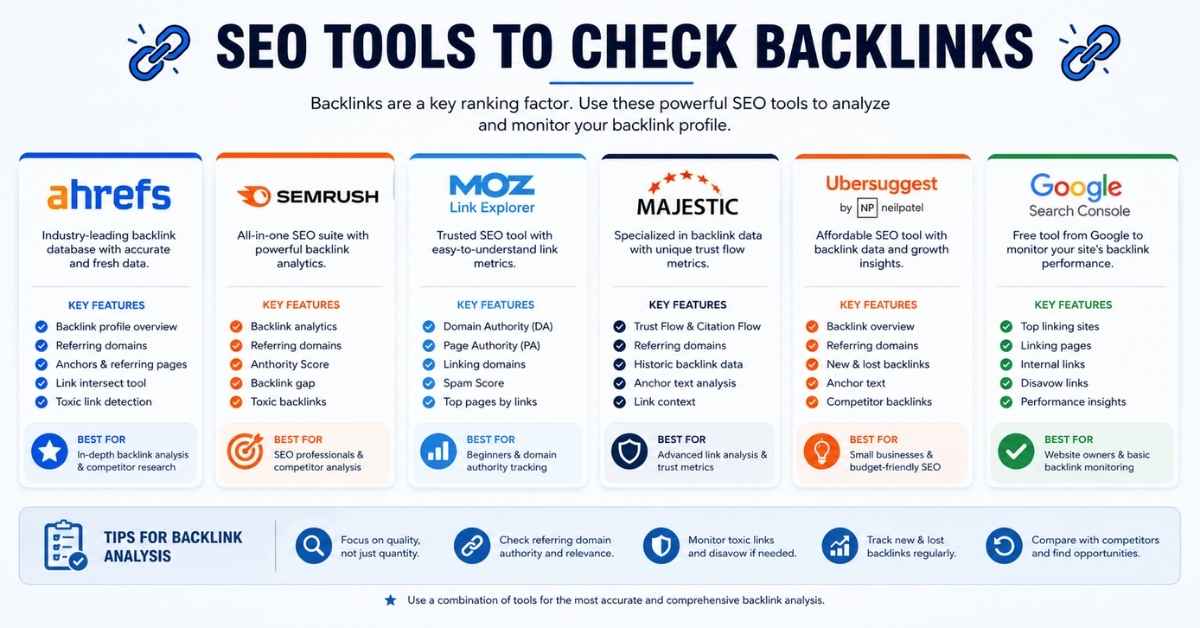
Compare reports instead of trusting one toxicity score.
Useful tools include:
- Google Search Console
- Ahrefs
- Semrush
- Moz
- Majestic
If multiple sources identify the same high-risk domains, investigate further.
Step 7: Prioritize Links by Risk
Create three categories:
| Risk Level | Action |
| Low | Monitor |
| Medium | Review manually |
| High | Attempt removal or disavow if appropriate |
Prioritizing prevents unnecessary work and reduces the chance of removing beneficial backlinks.
Professional Backlink Audit Workflow
- Export backlinks.
- Remove duplicate domains.
- Review referring domains.
- Analyze anchor text.
- Check topical relevance.
- Evaluate traffic quality.
- Identify manipulation patterns.
- Document findings.
- Contact webmasters if removal is necessary.
- Use the Google Disavow Tool only when justified.
Should You Remove, Ignore, or Disavow Toxic Backlinks?
This is one of the most misunderstood areas of SEO.
The best action depends on why the backlink exists and whether it poses a genuine risk.
When Ignoring Is the Best Option
Ignoring a backlink is often appropriate when:
- It appears naturally.
- Google is likely already ignoring it.
- The referring site has low authority but isn't manipulative.
- The link came from a scraper website.
- No manual action exists.
Sometimes, doing nothing is the smartest decision.
When Link Removal Makes Sense
Request removal if:
- The backlink was purchased.
- It belongs to a known link scheme.
- It comes from a hacked website.
- It clearly violates Google's spam policies.
Always keep records of your outreach efforts.
When to Use Google's Disavow Tool
Consider the Disavow Tool only when:
- You have received a manual action for unnatural links.
- You cannot remove harmful backlinks manually.
- Your backlink profile contains a significant number of manipulative links.
The tool tells Google to ignore specific backlinks during ranking evaluations.
Risks of Overusing the Disavow Tool
Disavowing valuable backlinks accidentally can reduce your site's authority.
Before adding a domain to your disavow file, confirm that the links are genuinely harmful—not simply low quality or unfamiliar.
What Happens After You Submit a Disavow File?
Google may take time to recrawl and process the affected links.
Recovery depends on factors such as:
- The severity of the issue.
- Whether a manual action was involved.
- The quality of your remaining backlink profile.
- Your site's overall SEO health.
Patience and continued monitoring are essential.
Decision Framework: Ignore links that are harmless, investigate suspicious patterns, request removal when links clearly violate spam policies, and use the Disavow Tool only as a last resort when there is a legitimate need. This measured approach aligns with modern SEO best practices and helps protect your website without sacrificing valuable link equity.
Can Competitors Hurt Your SEO with Toxic Backlinks?
Many website owners worry that a competitor can point thousands of spam backlinks at their site and destroy their rankings overnight. While this fear is understandable, the reality is much less dramatic.
Google has spent years improving its systems to detect and neutralize manipulative link schemes. In most cases, Google's algorithms are capable of ignoring low-quality or irrelevant backlinks rather than allowing them to negatively influence rankings.
That said, negative SEO is still possible in rare situations, particularly if your site already has a weak backlink profile or receives a manual action for unnatural links.
Understanding Negative SEO
Negative SEO refers to attempts to damage another website's search performance through unethical tactics instead of improving one's own site.
Common tactics include:
- Building thousands of spam backlinks
- Creating fake directory listings
- Using keyword-stuffed anchor text
- Copying content across scraper websites
- Hacking websites to insert malicious links
- Generating links from automated spam networks
Fortunately, modern search systems are much better at recognizing these patterns than they were years ago.
How Common Is Negative SEO?
For most small and medium-sized websites, negative SEO is uncommon.
Large brands, highly competitive industries, and websites with significant online visibility are more likely to experience deliberate spam attacks.
If your website suddenly receives hundreds of suspicious backlinks, don't panic. Investigate first before taking action.
How to Monitor Suspicious Activity
Develop a habit of reviewing your backlink profile regularly.
Monitor:
- New referring domains
- Anchor text changes
- Sudden backlink spikes
- Manual actions in Google Search Console
- Organic traffic trends
- Keyword ranking fluctuations
Monthly backlink audits are usually sufficient for most websites.
What to Do If You Suspect Negative SEO
Follow a structured process:
- Verify whether rankings have actually declined.
- Review backlinks in Google Search Console.
- Compare reports using trusted SEO tools.
- Identify obvious spam patterns.
- Contact webmasters when appropriate.
- Document your findings.
- Use Google's Disavow Tool only if necessary.
Case Scenario: Imagine your website receives 5,000 backlinks from unrelated gambling websites over a weekend. Instead of immediately disavowing every domain, first confirm whether your rankings changed, check for a manual action, and determine whether Google is already ignoring those links. Reacting emotionally can sometimes cause more harm than the backlinks themselves.
LEARN MORE: SEO tools to check backlinks
Toxic Backlink Myths That Still Mislead Website Owners
SEO advice evolves quickly, yet many outdated myths continue to circulate.
Myth: Every Toxic Backlink Hurts Rankings
Fact: Google can automatically ignore many spammy backlinks.
A suspicious backlink doesn't automatically reduce your rankings.
Myth: High Toxicity Scores Equal Google Penalties
Fact: Toxicity scores are created by SEO software—not by Google.
Use them as indicators for manual review rather than proof of a problem.
Myth: Every Suspicious Link Must Be Disavowed
Fact: Overusing the Disavow Tool can accidentally remove valuable link equity.
Always review links carefully before taking action.
Myth: More Backlinks Always Mean Better Rankings
Fact: A handful of high-quality, relevant editorial backlinks usually provide more value than thousands of low-quality links.
Quality consistently outweighs quantity.
Myth: Competitors Can Easily Destroy Your SEO
Fact: Modern spam detection systems make successful negative SEO much more difficult than many people believe.
Although no system is perfect, Google is significantly better at identifying manipulative backlink patterns than it was in the past.
Myth vs. Fact
| Myth | Reality |
| Every bad backlink hurts SEO. | Many spam links are ignored automatically. |
| Toxicity scores are Google's metric. | They are estimates created by SEO tools. |
| Disavow everything suspicious. | Review first and act only when justified. |
| More backlinks always improve rankings. | Relevant, trustworthy backlinks matter most. |
| Negative SEO always works. | Successful attacks are relatively uncommon today. |
How to Build a Healthier Backlink Profile
The best defense against toxic backlinks is building a strong, natural backlink profile over time.
Earn Editorial Backlinks
Create content that people genuinely want to reference.
Examples include:
- Original research
- Case studies
- Industry statistics
- Detailed tutorials
- Helpful tools
- Expert guides
Editorial backlinks remain one of the strongest trust signals in SEO.
Focus on Topical Relevance
A backlink from a highly relevant website often carries more value than several links from unrelated websites.
Prioritize quality over sheer volume.
Diversify Anchor Text Naturally
Healthy backlink profiles contain a balanced mix of:
- Brand names
- Naked URLs
- Partial-match keywords
- Generic phrases
- Descriptive anchor text
Avoid forcing exact-match keywords into every backlink.
Audit Your Backlinks Regularly
A monthly backlink review helps you:
- Detect spam early
- Monitor referring domains
- Identify unusual patterns
- Track link growth
- Protect your website's authority
Consistency is more effective than reacting only when rankings drop.
Avoid Risky Link-Building Tactics
Stay away from:
- Buying backlinks
- Link exchanges
- Automated link software
- Private Blog Networks
- Mass directory submissions
- Spam comments
- AI-generated link farms
Short-term gains often lead to long-term problems.
Monitor New Links Consistently
Set a recurring schedule to review:
- New backlinks
- Lost backlinks
- Anchor text distribution
- Referring domains
- Organic traffic trends
Small issues are much easier to manage before they become significant.
Expert Tip: The strongest backlink strategy isn't removing toxic links—it's consistently earning authoritative, relevant, and editorially earned backlinks that demonstrate trust and expertise.
Professional Toxic Backlink Audit Checklist
Use this checklist whenever you review your backlink profile.
Monthly Checklist
✔ Export backlinks from Google Search Console
✔ Review newly discovered referring domains
✔ Check topical relevance
✔ Analyze anchor text diversity
✔ Investigate sudden backlink spikes
✔ Review manual actions
✔ Identify suspicious patterns
✔ Document questionable backlinks
✔ Request removal when appropriate
✔ Update your disavow file only if genuinely necessary
Following a structured process helps you make informed decisions instead of reacting to alarming SEO tool reports.
Frequently Asked Questions
Can one toxic backlink hurt my website?
Usually, no. One isolated spam backlink rarely causes ranking problems. Google often ignores individual low-quality links unless they are part of a larger manipulative pattern.
Are backlinks from unrelated websites always harmful?
No. Some unrelated backlinks occur naturally and aren't considered spam. Context and intent matter more than niche alone.
Do AI-generated websites create toxic backlinks?
Not necessarily. A website using AI to assist content creation isn't automatically harmful. However, large AI-generated spam networks built solely for manipulating rankings can produce toxic backlinks.
How often should I audit my backlinks?
For most websites, once a month is sufficient. Larger websites or highly competitive businesses may benefit from more frequent monitoring.
Can toxic backlinks cause a Google penalty?
Yes, but typically only when they are part of deliberate link schemes or result in a manual action. Random spam backlinks rarely trigger penalties on their own.
How long does it take to recover after removing harmful backlinks?
Recovery varies. If a manual action is involved, improvements may occur after Google reviews your reconsideration request. Algorithmic changes depend on recrawling and ongoing ranking evaluations.
Should small websites worry about toxic backlinks?
Small websites should stay informed, but they shouldn't panic over every suspicious backlink. Focus on building high-quality content and earning trustworthy backlinks.
Are third-party toxicity scores accurate?
They are useful for identifying potentially risky backlinks, but they should never replace manual analysis. Google's evaluation methods differ from the scoring systems used by SEO tools.
Key Takeaways
Understanding toxic backlinks is less about fear and more about making informed SEO decisions.
Here's what to remember:
- Not every low-quality backlink is toxic.
- Google ignores many spammy backlinks automatically.
- Manual actions are far more serious than tool-generated toxicity scores.
- Always investigate before removing or disavowing backlinks.
- Focus on earning relevant, editorial backlinks rather than obsessing over every suspicious link.
- Regular backlink audits help you identify genuine risks while avoiding unnecessary SEO mistakes.
A strong backlink profile isn't built overnight. It's created through valuable content, consistent monitoring, ethical link-building, and a commitment to quality over quantity.
When you understand how Google evaluates backlinks—and resist the temptation to react to every alarming metric—you'll make smarter SEO decisions that support long-term organic traffic, topical authority, and sustainable search rankings.
By following the frameworks, audit process, and best practices outlined in this guide, you'll be well-equipped to identify genuinely harmful backlinks, protect your website from spam, and build a backlink profile that strengthens your visibility in search results for years to come.