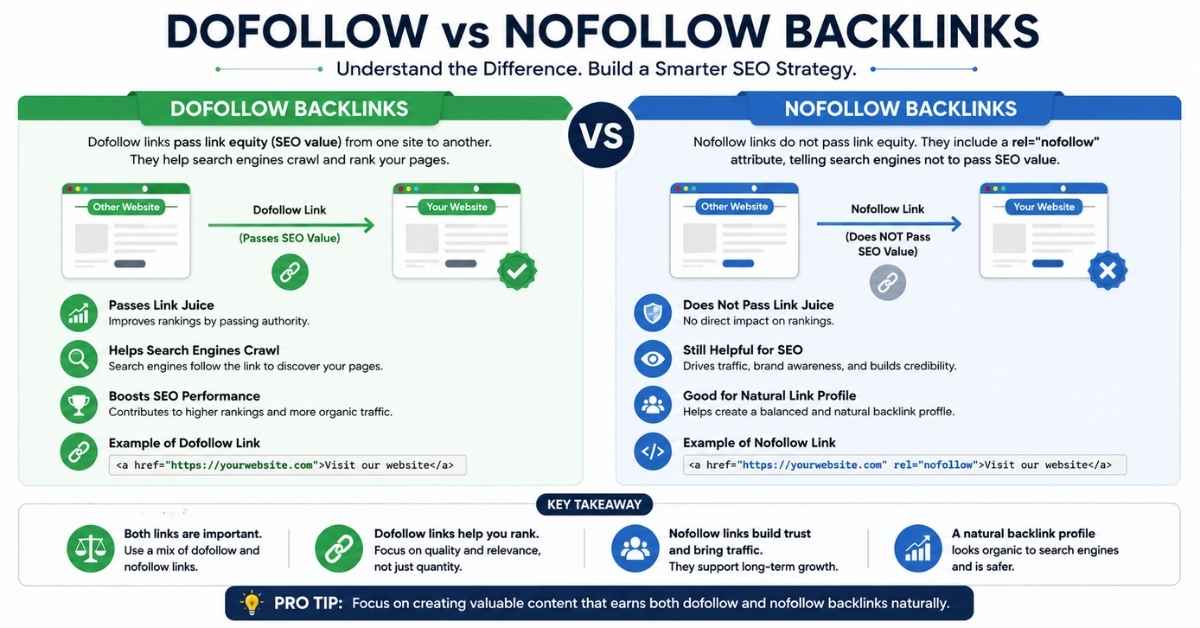
Dofollow vs Nofollow Backlinks are two types of links that influence SEO in different ways. Dofollow backlinks can pass link equity (PageRank) and help improve search rankings, while nofollow backlinks tell search engines that the link should not directly pass ranking signals.
However, in today's SEO landscape, both types of backlinks play an important role in building a natural backlink profile, increasing referral traffic, strengthening brand authority, and improving long-term search visibility.
This dofollow vs nofollow backlinks guide explains their differences, when to use each one, and how to build a smarter backlink strategy that aligns with Google's best practices.
Dofollow vs Nofollow Backlinks at a Glance
Choosing between dofollow and nofollow backlinks isn't about deciding which is "better." Instead, it's about understanding how each contributes to a balanced SEO strategy.
| Feature | Dofollow | Nofollow |
| Passes link equity | Yes | No (treated as a hint) |
| Direct ranking impact | High | Indirect |
| Referral traffic | Yes | Yes |
| Brand visibility | Yes | Yes |
| Helps build authority | Yes | Yes |
| Best for | Editorial links | Sponsored content, comments, forums |
| Natural backlink profile | Essential | Equally important |
A healthy website earns both dofollow and nofollow backlinks over time.
What Are Dofollow and Nofollow Backlinks?
What Is a Dofollow Backlink?
A dofollow backlink is a standard hyperlink that allows search engines to follow the link and pass link equity from one webpage to another. These links can contribute to organic rankings when they come from relevant and trustworthy websites.
Editorial mentions, guest posts, resource pages, and naturally earned citations commonly provide valuable dofollow links.
What Is a Nofollow Backlink?
A nofollow backlink contains the rel="nofollow" attribute. It tells search engines that the publisher does not want to pass ranking signals through that link.
Although nofollow links may not directly transfer PageRank, they still provide valuable benefits such as:
- Referral traffic
- Brand exposure
- Audience growth
- Natural link diversity
- Potential future editorial mentions
Dofollow vs Nofollow Backlinks Explained With HTML Examples
A normal dofollow link:
<a href="https://example.com">Visit Example</a>
A nofollow link:
<a href="https://example.com" rel="nofollow">Visit Example</a>
A sponsored link:
<a href="https://example.com" rel="sponsored">Sponsored Link</a>
A user-generated content (UGC) link:
<a href="https://example.com" rel="ugc">Forum Link</a>
Understanding these HTML link attributes helps you use the correct attribute for different situations.
Dofollow vs Nofollow Backlinks Guide: Key Differences You Need to Know
The easiest way to understand the difference is by comparing their practical SEO impact.
| Feature | Dofollow | Nofollow |
| Link equity | Passes authority | Usually does not pass authority directly |
| Google crawling | Fully crawlable | May still be crawled |
| SEO impact | Direct | Mostly indirect |
| Referral traffic | High | High |
| Brand awareness | Strong | Strong |
| Editorial trust | Excellent | Valuable |
| Ideal use | Editorial recommendations | Sponsored, comments, user-generated content |
This dofollow vs nofollow backlinks explained comparison shows that both link types serve different but complementary purposes.
Why Google Uses Different Link Attributes
Google introduced different link attributes to improve transparency and reduce spam.
Google's Link Evolution
Originally, rel="nofollow" acted as a strict instruction not to follow certain links. Today, Google generally treats it as a hint, meaning it may still use the link for discovery and evaluation in some situations.
To provide additional context, Google also introduced:
- rel="sponsored" for paid or sponsored links.
- rel="ugc" for user-generated content such as forums and comments.
Using the correct attribute helps search engines better understand the purpose of each link.
Which Is Better for SEO: Dofollow or Nofollow Backlinks?
The answer depends on your goals.
When Dofollow Links Deliver the Most Value
Prioritize dofollow backlinks when they come from:
- Relevant websites
- Editorially placed content
- Trusted industry publications
- High-quality guest posts
- Resource pages
These links contribute directly to your website's authority.
Why Nofollow Links Still Matter
Many website owners mistakenly ignore nofollow opportunities. In reality, nofollow backlinks can:
- Drive qualified visitors
- Increase brand recognition
- Generate social proof
- Lead to future editorial links
- Diversify your backlink profile
For example, a mention on a major news website or a popular community platform can send thousands of visitors even if the link is nofollow.
Build a Natural Backlink Profile
Google expects websites to earn a natural mix of link types. A profile containing only dofollow backlinks may appear manipulated, while a balanced profile reflects genuine popularity and trust.
Real-Life Examples of Dofollow and Nofollow Backlinks
Understanding real scenarios makes backlink decisions easier.
| Source | Link Type | SEO Value | Traffic Value |
| Guest post | Usually Dofollow | High | High |
| News mention | Often Nofollow | Moderate | High |
| Social media | Mostly Nofollow | Indirect | High |
| Wikipedia citation | Nofollow | Indirect | High |
| Forum discussion | UGC | Moderate | Moderate |
Each example demonstrates that backlink value extends beyond ranking signals.
How to Check if a Backlink Is Dofollow or Nofollow
You don't need advanced technical skills to inspect a backlink.
Browser Inspection
Right-click the link and select Inspect. If you see rel="nofollow", rel="ugc", or rel="sponsored", the link uses that attribute.
View Page Source
Open the page source and search for the destination URL to inspect its HTML attributes.
SEO Browser Extensions
Several browser extensions highlight dofollow and nofollow links automatically, making audits faster.
SEO Tools
A comprehensive backlink audit using professional SEO software can also identify:
- Link attributes
- Anchor text
- Referring domains
- Website authority
- Link relevance
The SMART Backlink Strategy
Instead of chasing every backlink opportunity, evaluate each one carefully.
S – Source Authority
Is the website trusted in its niche?
M – Market Relevance
Does the audience match your business?
A – Audience Value
Will real people click the link?
R – Referral Potential
Can the backlink generate meaningful traffic?
T – Trustworthiness
Does the website publish quality editorial content?
This framework helps prioritize backlinks that provide both SEO and business value.
Common Myths About Dofollow and Nofollow Backlinks
Myth: Nofollow Links Have No Value
False. They contribute to referral traffic, brand awareness, and a natural backlink profile.
Myth: More Dofollow Links Always Mean Better Rankings
Quality matters far more than quantity. A few trusted editorial backlinks often outperform hundreds of low-quality links.
Myth: Social Media Links Are Useless
Social platforms can increase visibility, encourage sharing, and lead to valuable editorial backlinks.
Myth: Every Link Must Pass PageRank
Many worthwhile opportunities focus on reputation, exposure, and audience growth rather than direct ranking signals.
Mistakes That Can Hurt Your Backlink Profile
Avoid these common errors:
- Buying low-quality backlinks
- Ignoring relevant nofollow opportunities
- Over-optimizing anchor text
- Building links from unrelated websites
- Focusing only on domain metrics instead of relevance
- Participating in manipulative link schemes
A strong backlink profile prioritizes quality, relevance, and trust.
LEARN MORE: Increase guest post credibility
How to Build a Healthy Backlink Profile in 2026
The most sustainable strategy combines multiple link sources.
Focus on:
- Editorial backlinks
- Digital PR
- High-quality guest posting
- Industry resource pages
- Brand mentions
- Relevant business citations
- Helpful community participation
Monitor your backlink profile regularly and remove or disavow harmful links only when appropriate.
Dofollow vs Nofollow Backlinks: Which Should You Focus On?
The answer depends on your website.
| Website Type | Recommended Strategy |
| New blog | Earn both naturally through quality content |
| Local business | Focus on citations, reviews, and editorial mentions |
| E-commerce | Build product reviews, digital PR, and guest posts |
| SaaS | Invest in thought leadership and editorial backlinks |
| Affiliate site | Prioritize authoritative niche publications |
Rather than chasing only one link type, build relationships that naturally generate diverse backlinks.
Frequently Asked Questions
Are nofollow backlinks good for SEO?
Yes. They provide indirect SEO benefits through referral traffic, brand exposure, trust, and a balanced backlink profile.
Do dofollow backlinks directly improve rankings?
Yes, when they come from relevant, trustworthy websites with strong editorial standards.
Can nofollow backlinks drive traffic?
Absolutely. Many high-traffic websites use nofollow links that still send qualified visitors.
Should every backlink be dofollow?
No. A natural backlink profile includes a healthy combination of dofollow, nofollow, sponsored, and UGC links.
What is the ideal backlink mix?
There is no perfect ratio. Focus on earning relevant, high-quality backlinks naturally instead of targeting specific percentages.
Final Thoughts
Understanding Dofollow vs Nofollow Backlinks is essential for building a successful SEO strategy. While dofollow backlinks remain valuable for passing link equity and improving rankings, nofollow backlinks contribute through referral traffic, brand authority, and a more natural backlink profile.
Instead of asking which backlink is better, ask whether the link comes from a relevant, trustworthy, and authoritative source. By focusing on quality, relevance, user value, and ethical link building, you'll create a backlink profile that supports sustainable SEO growth well beyond 2026.