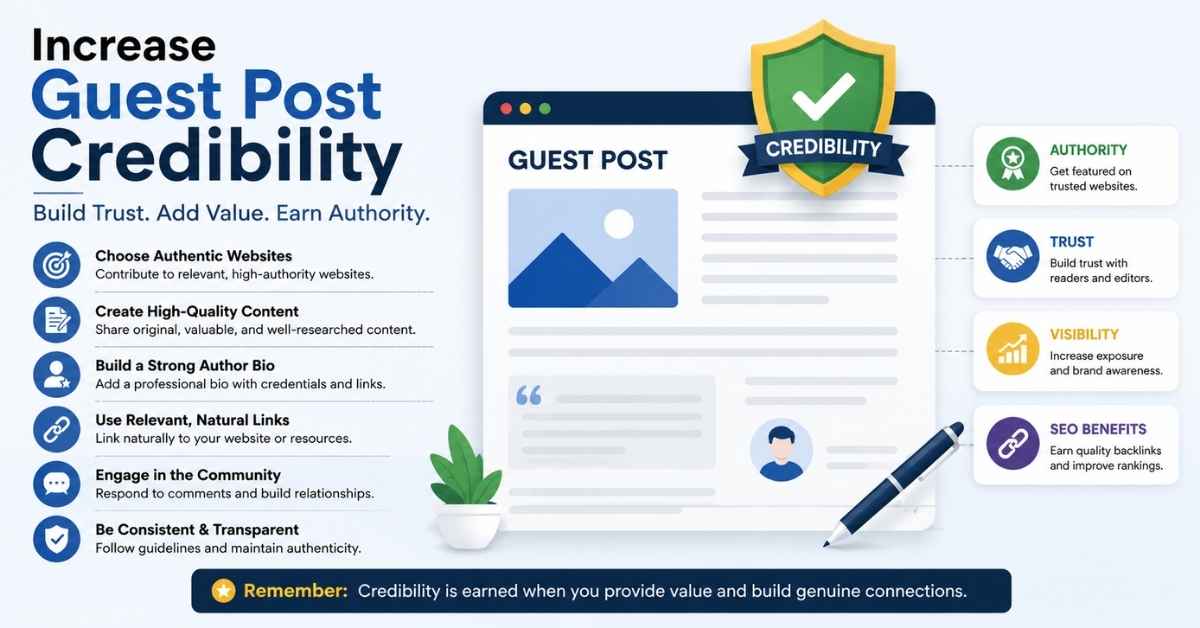
Increase guest post credibility by creating original, well-researched, reader-focused content backed by trustworthy sources, real experience, and a strong author profile. A credible guest post doesn't just earn a backlink—it builds trust, establishes authority, and encourages readers to engage with your brand.
In 2026, publishers and search engines value high-quality guest posts that demonstrate Experience, Expertise, Authoritativeness, and Trustworthiness (EEAT). This guide explains exactly how to make your guest post credibility stand out with practical strategies that editors and readers appreciate.
Why Guest Post Credibility Matters More Than Ever in 2026
Guest blogging has evolved. Years ago, many marketers focused mainly on acquiring backlinks. Today, successful guest blogging is about earning trust and becoming a recognized voice within your niche.
A credible guest post delivers genuine value, answers readers' questions, and reflects your expertise. Publishers are more selective, and search engines reward content that demonstrates content quality, reader value, and trust signals instead of promotional messaging.
When your content is credible, it can:
- Increase referral traffic
- Strengthen your brand authority
- Improve audience engagement
- Build long-term relationships with publishers
- Support sustainable SEO growth
What Makes a Guest Post Truly Credible?
Many people believe publishing on a high-authority website automatically creates credibility. While the publication's reputation helps, the real trust comes from the quality of your content.
Credibility vs. Publishing on a High-Authority Website
A guest article on a popular website can still fail if it contains weak research, generic advice, or excessive self-promotion. Likewise, a thoughtful article on a smaller niche blog can establish strong guest blogging authority if it demonstrates expertise and solves real problems.
The Four Pillars of Guest Post Credibility
1. Expertise
Write about subjects you genuinely understand. Share practical knowledge instead of repeating information found elsewhere.
2. Evidence
Support important claims using authoritative sources, recent statistics, or industry research whenever appropriate.
3. Transparency
Avoid exaggerated promises. Be honest about limitations, alternatives, and realistic outcomes.
4. Reader Value
Every section should help readers solve a specific problem instead of simply promoting products or services.
How Editors Decide Whether Your Guest Post Deserves to Be Published
Editors review dozens of submissions every week. Understanding their perspective can significantly improve guest post quality.
The First Things Editors Notice
Editors usually evaluate:
- A compelling headline
- A helpful introduction
- Logical formatting
- Original insights
- Natural readability
- A professional author bio
A strong first impression often determines whether they continue reading.
Common Reasons Guest Posts Get Rejected
Many submissions fail because they contain:
- Thin content
- Generic AI-like writing
- Keyword stuffing
- Weak research
- Promotional language
- Poor formatting
- Irrelevant outbound links
- Failure to follow editorial guidelines
Thinking like an editor before submitting your article dramatically increases acceptance rates.
15 Proven Ways to Increase Guest Post Credibility
1. Write From Real Experience
Readers trust personal experience more than recycled advice. Explain what worked, what didn't, and why. Authentic insights naturally demonstrate experience and make your content memorable.
2. Support Every Important Claim With Evidence
Whenever you discuss industry trends or performance improvements, support them using credible sources, research papers, or respected publications. Evidence strengthens reader trust.
3. Cite Trusted Sources Naturally
Use reputable industry publications, government websites, academic studies, or original research instead of random blogs. Quality citations increase trustworthiness.
4. Add Original Insights
Don't simply summarize other articles. Offer your own perspective, practical observations, or lessons learned from real projects. Originality distinguishes your article from competitors.
5. Solve One Problem Completely
Instead of covering dozens of topics briefly, focus on answering one question thoroughly. Comprehensive content often performs better than broad but shallow articles.
6. Include Real Examples
Examples help readers understand complex concepts quickly.
Instead of saying:
"Use strong evidence."
Show how replacing vague claims with verified data improves credibility.
7. Avoid Promotional Language
Readers quickly lose trust when every paragraph promotes a service or product. Educate first and sell later.
8. Create a Strong Author Bio
A professional author bio supports EEAT by demonstrating your expertise, experience, and niche knowledge. Mention relevant qualifications, achievements, or years of experience where appropriate.
9. Use Recent Statistics
Fresh data signals that your content is current. Whenever possible, reference up-to-date industry research instead of outdated numbers.
10. Write for Humans First
Natural language improves readability and creates a better user experience. Use semantic keywords naturally rather than forcing exact-match phrases repeatedly.
11. Improve Readability
Break long paragraphs into shorter sections, use descriptive headings, and organize ideas logically. Readers appreciate content that's easy to scan.
12. Use Internal and External Links Wisely
Relevant internal links improve navigation, while carefully selected external references strengthen authority and provide additional context.
13. Proofread Carefully
Grammar mistakes, broken links, and formatting issues reduce credibility instantly. Review your article before submission.
14. Follow Editorial Guidelines
Every publisher has different expectations regarding formatting, links, images, and tone. Respecting those requirements shows professionalism.
15. Verify Facts Before Publishing
Double-check statistics, names, dates, and references. Accurate information reinforces content quality and protects your reputation.
Guest Post Credibility Checklist Before Submission
Use this checklist before clicking the submit button:
| Checklist Item | Status |
| Original content | ✓ |
| Clear headline | ✓ |
| Helpful introduction | ✓ |
| Reliable sources cited | ✓ |
| Natural keyword placement | ✓ |
| Grammar checked | ✓ |
| Professional author bio | ✓ |
| Editorial guidelines followed | ✓ |
| Internal and external links reviewed | ✓ |
| Final proofread completed | ✓ |
Following this guest post credibility checklist can significantly improve acceptance rates.
Mistakes That Instantly Damage Guest Post Credibility
Even well-written articles can lose credibility because of avoidable mistakes.
Overusing Keywords
Keyword stuffing makes content difficult to read and appears manipulative. Use your primary keyword, secondary keywords, and LSI keywords naturally within the context.
Publishing Generic AI-Like Content
Readers recognize repetitive advice. Add personal observations, practical tips, and unique explanations to stand out.
Making Unsupported Claims
Avoid statements such as "This strategy always works" unless you provide supporting evidence.
Using Weak Sources
Low-quality references reduce trust. Choose authoritative and relevant sources whenever possible.
Ignoring Reader Intent
Your article should answer readers' questions instead of focusing solely on SEO.
LEARN MORE: Off page SEO techniques
How to Demonstrate EEAT in Every Guest Post
Google values content created by people who demonstrate Experience, Expertise, Authoritativeness, and Trustworthiness.
You can naturally strengthen EEAT by:
- Sharing first-hand experience
- Using evidence-based writing
- Citing trustworthy resources
- Being transparent about limitations
- Writing accurate, reader-focused content
- Maintaining a professional author profile
Rather than claiming to be an expert, let the quality of your explanations prove it.
Before-and-After Example
Weak Version
"Our marketing strategy is the best because it increases website traffic."
Improved Version
"After testing multiple outreach strategies over six months, we found that personalized pitches combined with evidence-backed guest posts consistently generated higher engagement and stronger publisher relationships. Including relevant examples and authoritative references made editors more likely to approve submissions."
Why the Improved Version Works
The revised version is more convincing because it includes:
- Specific experience
- Practical context
- Clear reasoning
- Reader-focused value
- Stronger trust signals
Expert Tips to Make Your Guest Posts Stand Out
To consistently produce trustworthy guest blogging content:
- Research the publisher's audience before writing.
- Study previously published articles.
- Include actionable takeaways.
- Explain complex ideas using simple language.
- Keep your writing conversational.
- Update outdated examples regularly.
- Focus on solving problems rather than selling.
These habits help establish thought leadership while improving long-term credibility.
Frequently Asked Questions
How can I make my guest post more trustworthy?
Use original insights, cite authoritative sources, provide practical examples, and maintain a helpful, unbiased tone throughout the article.
Does citing sources improve guest post credibility?
Yes. Reliable references strengthen your arguments, demonstrate research, and increase reader confidence.
Can a new website publish credible guest posts?
Absolutely. Credibility depends more on the quality of the content, expertise, and usefulness than on the age of the website.
How long should a credible guest post be?
The ideal length depends on the publisher's guidelines, but every section should provide meaningful value without unnecessary filler.
Should every guest post include statistics?
Not necessarily. Include statistics when they support your point, but avoid adding numbers solely for the sake of appearing authoritative.
Does an author bio matter?
Yes. A well-written author bio helps establish authority, highlights your expertise, and builds trust with both editors and readers.
Final Thoughts
Building guest post credibility is about much more than earning backlinks. It's about demonstrating expertise, delivering reader value, supporting claims with reliable evidence, and maintaining complete transparency throughout your writing.
If you consistently create credible guest posts that solve real problems, respect editorial standards, and prioritize readers over promotion, you'll build stronger relationships with publishers, improve your brand reputation, and create lasting SEO value. In today's search landscape, trust is your most valuable asset, and every guest post is an opportunity to strengthen it.