Link Building ROI Guide is the process of measuring whether your link-building investment generates more business value than it costs. Instead of judging success by the number of backlinks you earn, a proper ROI analysis focuses on organic traffic, keyword rankings, qualified leads, conversions, and revenue. If you're investing in guest posting, digital PR, editorial backlinks, or outreach campaigns, understanding your return on investment helps you identify what's working, eliminate wasted spending, and scale profitable SEO strategies.
Many businesses spend thousands of dollars on backlinks without knowing whether those links actually increase sales. That's where ROI becomes essential. By tracking the right KPIs, using tools like Google Analytics 4 (GA4), Google Search Console, Ahrefs, Semrush, and Looker Studio, and connecting SEO performance with business outcomes, you can make informed decisions instead of relying on assumptions.
In this guide, you'll learn how to calculate link building ROI, which metrics matter most, common mistakes that reduce profitability, and practical ways to maximize the value of every backlink you earn.
Is Link Building Worth the Investment?
Yes—when done correctly, link building remains one of the highest-return long-term SEO investments. High-quality backlinks help search engines recognize your website as trustworthy and authoritative. As your authority grows, your pages are more likely to rank for competitive keywords, attract qualified visitors, and generate sustainable revenue.
However, not every backlink delivers a positive ROI. Buying irrelevant links, focusing only on Domain Rating (DR) or Domain Authority (DA), or ignoring conversion tracking often results in disappointing outcomes.
The businesses that see the strongest returns focus on:
- Editorial, relevant backlinks
- Topical authority
- Commercial-intent pages
- Content quality
- Accurate conversion tracking
- Long-term SEO growth
The goal isn't to build the most links—it's to build the right links that support measurable business growth.
What Is Link Building ROI?
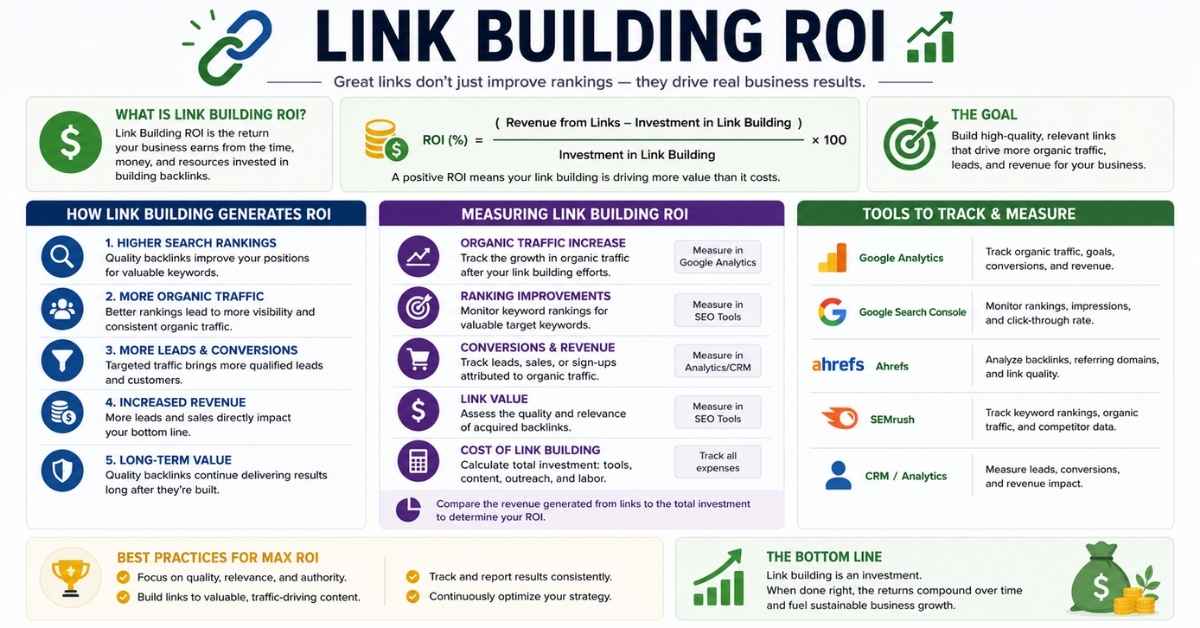
Link Building ROI measures how much financial value your backlink campaign generates compared to the money invested.
The standard formula is:
ROI = (Revenue Generated – Campaign Cost) ÷ Campaign Cost × 100
For example:
- Campaign Cost: $3,000
- Revenue from Organic Search: $12,000
ROI:
(($12,000 – $3,000) ÷ $3,000) × 100 = 300% ROI
This means every dollar invested returned three dollars in profit.
SEO Metrics vs Business Metrics
Many marketers still rely on vanity metrics. While useful for analysis, they don't tell the complete business story.
| Vanity Metrics | Business Metrics |
| Domain Rating (DR) | Revenue |
| Domain Authority (DA) | Profit |
| Referring Domains | Qualified Leads |
| Anchor Text | Customer Acquisition Cost (CAC) |
| Number of Backlinks | Customer Lifetime Value (CLV) |
| Keyword Rankings | Return on Investment (ROI) |
A growing Domain Rating is encouraging, but if it doesn't increase organic conversions, it isn't delivering meaningful value.
How Link Building Creates Business Value
Every quality backlink contributes to a larger SEO ecosystem rather than acting as an isolated ranking signal.
The Link Building Value Chain
A successful campaign often follows this path:
High-Quality Backlinks → Improved Authority → Better Rankings → Increased Organic Traffic → More Conversions → Higher Revenue
Unlike paid advertising, these benefits often continue long after the campaign ends, making SEO ROI compound over time.
Direct Benefits
Quality backlinks can generate:
- Referral traffic
- Higher keyword rankings
- Improved crawl discovery
- Better indexing
- Greater brand visibility
Indirect Benefits
Backlinks also influence factors that are harder to measure but equally valuable, including:
- Brand trust
- Editorial credibility
- Assisted conversions
- Higher click-through rates
- Improved customer confidence
This is why experienced SEO professionals evaluate both direct and indirect ROI.
How to Calculate Link Building ROI Step by Step
Calculating ROI isn't difficult when you measure the right variables.
Step 1: Calculate Total Campaign Costs
Include every expense associated with the campaign.
Examples include:
- Content creation
- Guest posting fees
- Digital PR campaigns
- Outreach software
- Ahrefs or Semrush subscriptions
- Freelancers
- Internal team salaries
- Link prospecting
- Design costs
Ignoring hidden costs leads to inaccurate ROI calculations.
Step 2: Measure Organic Performance
Track performance using Google Search Console and Google Analytics 4.
Monitor:
- Organic sessions
- Keyword rankings
- Referring domains
- Landing page traffic
- Conversion rate
- Goal completions
- Revenue from organic visitors
Avoid focusing on rankings alone. Rankings are valuable only when they contribute to meaningful business outcomes.
Step 3: Attribute Revenue Correctly
One of the biggest challenges in SEO is attribution.
A visitor may:
- Discover your website through organic search.
- Leave without purchasing.
- Return later through a branded search.
- Finally convert after receiving an email.
This is why businesses should consider:
- First-click attribution
- Last-click attribution
- Data-driven attribution
- Assisted conversions
- Multi-touch attribution
Looking beyond the last interaction provides a more accurate picture of link-building performance.
Step 4: Apply the ROI Formula
Once you know both campaign costs and organic revenue, use the standard formula.
ROI = (Revenue – Cost) ÷ Cost × 100
For example:
| Metric | Value |
| Campaign Cost | $5,000 |
| Organic Revenue | $20,000 |
| Net Profit | $15,000 |
| ROI | 300% |
This simple calculation allows marketing teams to compare link building with other channels such as PPC, content marketing, digital PR, and paid social advertising, making budget decisions based on measurable performance rather than assumptions.
A Real Link Building ROI Example
Understanding the formula is useful, but seeing it in action makes it much easier to apply.
Example 1: SaaS Company
A B2B SaaS company invested in a six-month link building campaign focused on editorial backlinks from reputable industry websites.
| Metric | Result |
| Campaign Cost | $6,000 |
| High-Quality Backlinks Earned | 22 |
| Organic Traffic Increase | 48% |
| Qualified Leads | 120 |
| New Customers | 15 |
| Revenue Generated | $24,000 |
| ROI | 300% |
The campaign succeeded because the backlinks pointed to valuable content targeting commercial-intent keywords, which improved rankings and generated qualified leads.
Example 2: eCommerce Store
An online retailer focused on category pages and product buying guides.
Campaign Results:
- Investment: $4,000
- Editorial backlinks earned: 18
- Organic traffic growth: 35%
- Additional sales: 95
- Revenue generated: $15,500
- ROI: 287.5%
Instead of chasing hundreds of backlinks, the business earned links from highly relevant websites, demonstrating that quality consistently outperforms quantity.
Example 3: Local Business
A local home services company used digital PR, local citations, and niche outreach to strengthen its online presence.
After five months:
- Organic inquiries increased by 55%
- Phone calls nearly doubled
- Local keyword rankings improved significantly
- Monthly revenue increased consistently
This illustrates that link building ROI isn't limited to large brands. Local businesses can also achieve impressive returns with a focused strategy.
The Metrics That Actually Matter
Many SEO reports emphasize backlink counts or Domain Rating, but decision-makers care about business outcomes.
SEO Metrics Worth Tracking
Monitor these indicators to evaluate search performance:
- Organic traffic
- Keyword rankings
- Referring domains
- Editorial backlinks
- Link relevance
- Organic impressions
- Click-through rate (CTR)
- Index coverage
- Search visibility
These metrics show whether your backlink profile is strengthening your website's authority.
Business Metrics That Demonstrate ROI
The following KPIs reveal whether SEO contributes to growth:
- Revenue
- Qualified leads
- Sales
- Conversion rate
- Customer Acquisition Cost (CAC)
- Customer Lifetime Value (CLV)
- Profit margin
- Return on Investment (ROI)
A campaign should never be judged solely by improved rankings if it fails to generate measurable business value.
Executive KPIs
When presenting results to business leaders, focus on:
- Revenue growth
- Pipeline value
- Monthly recurring revenue (MRR) (for subscription businesses)
- Organic conversion rate
- Cost per acquisition
- Return on marketing investment
These metrics connect SEO performance directly to business objectives.
How to Track Link Building ROI with GA4 and Google Search Console
Tracking ROI becomes much easier when you build a consistent reporting process.
Set Up Conversion Tracking
Begin by configuring Google Analytics 4 (GA4) to track meaningful conversions, such as:
- Purchases
- Contact form submissions
- Quote requests
- Newsletter sign-ups
- Phone calls
- Demo bookings
Without conversion tracking, calculating SEO ROI becomes largely guesswork.
Measure Organic Growth
Use Google Search Console to monitor:
- Clicks
- Impressions
- Average position
- Queries
- Landing pages
Compare these metrics before and after your link-building campaign to identify meaningful improvements.
Identify High-Performing Pages
Not every page generates the same value.
Focus on pages that show:
- Increasing organic traffic
- Higher conversion rates
- Strong keyword improvements
- Commercial search intent
- Revenue-generating potential
These pages often deserve additional backlinks because they produce the greatest return.
Connect Rankings to Revenue
Combine data from:
- Google Analytics 4
- Google Search Console
- Ahrefs
- Semrush
- CRM software
- Looker Studio dashboards
This integrated approach allows you to connect improved rankings with leads, sales, and revenue rather than viewing SEO metrics in isolation.
Build a Monthly ROI Dashboard
A practical dashboard should include:
| KPI | Purpose |
| Organic Sessions | Measure traffic growth |
| Keyword Rankings | Monitor visibility |
| Referring Domains | Track backlink acquisition |
| Conversions | Evaluate business impact |
| Revenue | Measure financial return |
| ROI | Determine campaign profitability |
A monthly dashboard makes it easier to identify trends and justify future SEO investment.
Why Measuring SEO ROI Is More Difficult Than It Looks
Although the ROI formula is straightforward, real-world measurement is rarely simple.
Attribution Challenges
Customers rarely convert during their first visit.
A typical journey might look like this:
- Discover your website through organic search.
- Read several articles.
- Leave the website.
- Return later through a branded search.
- Receive an email.
- Complete a purchase.
In this situation, determining which interaction deserves credit requires a thoughtful attribution model.
Multiple SEO Factors Work Together
Improved rankings usually result from several combined efforts, including:
- Better content
- Technical SEO improvements
- Stronger internal linking
- Higher-quality backlinks
- Faster page speed
- Improved user experience
Backlinks contribute significantly, but they are rarely the only reason rankings improve.
Seasonal Changes
Some industries experience predictable fluctuations.
Examples include:
- Holiday shopping
- Tax season
- Summer travel
- Back-to-school periods
Comparing campaign performance without accounting for seasonality may produce misleading conclusions.
Brand Searches
As your brand becomes more visible through digital PR and backlinks, branded searches often increase.
This indirect benefit strengthens overall organic performance, even though it may not be directly attributed to individual backlinks.
Assisted Conversions
Many users interact with multiple marketing channels before converting.
For example:
- Organic search
- Social media
- Email marketing
- Paid advertising
Understanding assisted conversions provides a more complete picture of your campaign's contribution.
Time Lag Between Links and Results
Unlike paid advertising, link building requires patience.
Most campaigns begin showing measurable improvements within:
- 3–6 months for moderate competition
- 6–12 months for highly competitive industries
Expecting immediate ROI often leads businesses to abandon effective campaigns too early.
What Does a Good Link Building ROI Look Like?
There is no universal benchmark because every industry, competition level, and business model differs.
Generally, a healthy campaign demonstrates:
- Consistent ranking improvements
- Increasing organic traffic
- Growing conversion rates
- Revenue that exceeds campaign costs
- Sustainable long-term growth
Industry Differences
SaaS
Higher customer lifetime value often produces excellent long-term ROI despite longer sales cycles.
eCommerce
Revenue may increase quickly when backlinks strengthen high-converting category and product pages.
Local Businesses
Even a small increase in qualified leads can generate significant returns because local services typically have high conversion rates.
B2B Companies
ROI often develops more slowly due to longer buying cycles, but contract values can produce exceptional profitability.
When Should You Scale?
Consider increasing your investment when you observe:
- Consistent revenue growth
- Stable conversion rates
- Positive ROI over several months
- Improved keyword visibility
- Growing organic market share
When Should You Stop or Reevaluate?
Review your strategy if:
- Organic traffic remains stagnant.
- Low-quality backlinks dominate your profile.
- Revenue doesn't improve despite higher rankings.
- Conversions continue declining.
- Campaign costs consistently exceed returns.
Optimization—not simply acquiring more backlinks—is often the solution.
The Biggest Reasons Link Building Campaigns Fail
Even experienced marketers encounter disappointing campaigns. Understanding the most common mistakes can help you avoid costly setbacks.
Low-Quality Backlinks
Spammy or irrelevant backlinks rarely produce lasting value and may undermine trust over time.
Weak Content Assets
Even outstanding outreach struggles if the linked content fails to provide unique value.
Poor Outreach
Generic outreach emails often receive low response rates and limit opportunities for earning editorial backlinks.
Wrong KPIs
Measuring only Domain Authority, Domain Rating, or backlink quantity ignores the metrics that truly matter—traffic, leads, conversions, and revenue.
Unrealistic Expectations
SEO compounds over time. Expecting substantial returns after only a few weeks often leads to poor decision-making.
Tracking the Wrong Metrics
Successful businesses evaluate the complete customer journey instead of relying on isolated ranking improvements.
A profitable link-building strategy is built on quality content, relevant backlinks, accurate measurement, and continuous optimization—not simply acquiring more links.
Proven Ways to Increase Your Link Building ROI
Building backlinks is only half the job. The real goal is to maximize the return from every link you earn. These strategies consistently produce better long-term results.
Earn Fewer but Better Backlinks
A handful of editorial backlinks from highly relevant, authoritative websites often outperform hundreds of low-quality links.
Prioritize websites that have:
- Strong topical relevance
- Real organic traffic
- Genuine editorial standards
- Engaged audiences
- Natural outbound link profiles
Quality, relevance, and trust should always outweigh quantity.
Improve Content Before Building Links
Even the best outreach campaign won't succeed if the content isn't worth linking to.
Create assets such as:
- Original research
- Industry statistics
- Comprehensive guides
- Case studies
- Free templates
- Calculators
- Infographics
- Expert roundups
Content that solves real problems naturally attracts more backlinks and improves SEO profitability.
Focus on Commercial-Intent Pages
Many websites build links only to blog posts.
While informational content earns links, don't overlook pages that generate revenue, including:
- Service pages
- Product category pages
- Pricing pages
- Comparison pages
- Buying guides
Improving authority for these pages often delivers a higher return on investment.
Strengthen Internal Linking
A strong internal linking strategy distributes authority from high-performing pages to important commercial pages.
Benefits include:
- Better crawlability
- Improved page authority
- Faster indexation
- Stronger keyword rankings
Recover Lost Backlinks
Losing quality backlinks can reduce rankings and organic traffic.
Regularly audit your backlink profile using Ahrefs or Semrush to:
- Identify lost backlinks
- Contact publishers
- Restore broken links
- Update outdated URLs
Recovering existing links is often easier and more cost-effective than acquiring new ones.
Build Topical Authority
Rather than creating isolated articles, publish interconnected content around your niche.
For example, a link-building content hub could include:
- Link Building ROI Guide
- Guest Posting Guide
- Editorial Link Building
- Digital PR Strategies
- Anchor Text Optimization
- Link Audit Guide
- Backlink Quality Assessment
This approach strengthens semantic SEO, improves topical authority, and helps search engines understand your expertise.
Refresh Existing Content
Updating successful articles with:
- New statistics
- Fresh examples
- Current screenshots
- Updated tools
- Recent SEO trends
can improve rankings without starting from scratch.
Link Building vs. Other Marketing Channels
Every marketing channel serves a different purpose. Understanding how link building compares helps allocate budgets more effectively.
| Marketing Channel | Time to Results | Upfront Cost | Long-Term Value | Typical ROI Considerations |
| Link Building | Medium | Medium–High | Very High | Compounds over time and supports sustainable organic growth |
| PPC Advertising | Fast | High | Low after spending stops | Delivers immediate traffic but requires continuous investment |
| Content Marketing | Medium | Medium | High | Produces lasting traffic when combined with quality backlinks |
| Digital PR | Medium | High | High | Builds authority, brand awareness, and editorial links |
| Social Media Ads | Fast | Medium | Medium | Effective for short-term campaigns and promotions |
Unlike paid advertising, organic visibility gained through quality backlinks can continue generating traffic long after the campaign ends, making link building one of the most valuable long-term SEO investments.
A Practical Link Building ROI Framework
Use this repeatable process every month to measure and improve performance.
Step 1: Define Business Goals
Set measurable objectives such as:
- Increase organic revenue
- Generate qualified leads
- Improve conversions
- Grow search visibility
Step 2: Choose Meaningful KPIs
Track metrics that directly influence business growth:
- Organic traffic
- Conversion rate
- Revenue
- Customer Acquisition Cost (CAC)
- Customer Lifetime Value (CLV)
- Return on Investment (ROI)
Step 3: Record Every Campaign Cost
Include:
- Outreach expenses
- Content creation
- Freelancers
- SEO tools
- Digital PR
- Guest posting fees
- Internal team costs
Complete cost tracking produces a more accurate ROI calculation.
Step 4: Measure Organic Performance
Monitor:
- Keyword rankings
- Organic sessions
- Referring domains
- Landing page performance
- Leads
- Sales
Step 5: Attribute Revenue
Use Google Analytics 4, Google Search Console, CRM software, and Looker Studio dashboards to connect SEO performance with business outcomes.
Step 6: Calculate ROI
Apply the formula consistently every reporting period.
ROI = (Revenue – Campaign Cost) ÷ Campaign Cost × 100
Tracking the same formula monthly makes trends easier to identify.
Step 7: Optimize Future Campaigns
Evaluate:
- Which content attracted the strongest backlinks?
- Which outreach methods produced the best results?
- Which pages generated the highest revenue?
- Which campaigns delivered the greatest ROI?
Use these insights to improve future campaigns.
LEARN MORE: Toxic Backlinks Explained
Common Mistakes That Reduce Link Building ROI
Avoiding these mistakes can significantly improve campaign performance.
- Buying low-quality backlinks simply because they're inexpensive.
- Focusing only on Domain Rating (DR) or Domain Authority (DA).
- Ignoring search intent when choosing pages to promote.
- Building links to weak or outdated content.
- Tracking rankings but ignoring conversions.
- Stopping campaigns before results have time to compound.
- Neglecting backlink audits and lost-link recovery.
- Failing to align SEO goals with overall business objectives.
Successful SEO campaigns prioritize business growth, not vanity metrics.
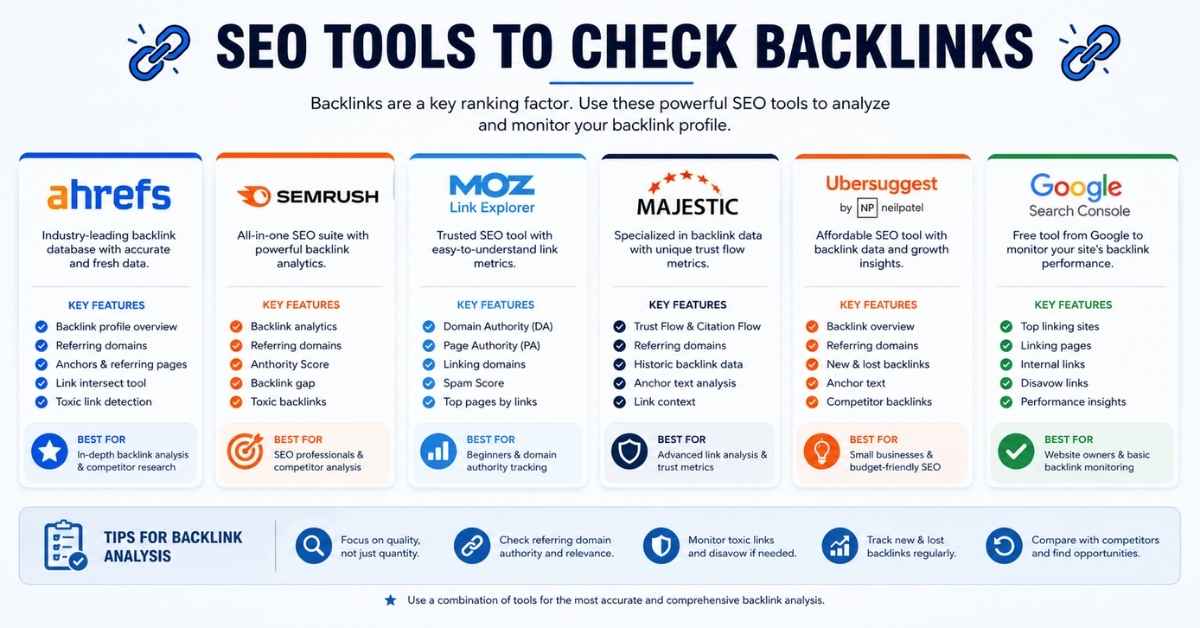
Best Tools for Measuring Link Building ROI
The right tools simplify reporting and improve decision-making.
| Tool | Primary Purpose |
| Google Analytics 4 (GA4) | Track traffic, conversions, and revenue |
| Google Search Console | Monitor search performance and indexing |
| Ahrefs | Analyze backlinks and referring domains |
| Semrush | Track keywords, competitors, and backlinks |
| Looker Studio | Build custom SEO dashboards |
| HubSpot or Other CRM | Attribute leads and revenue to organic traffic |
Using these tools together creates a complete picture of campaign performance.
Expert Tips to Maximize Every Backlink
Experienced SEO professionals consistently apply these principles:
- Prioritize topical relevance over authority alone.
- Build backlinks that support pages with commercial value.
- Combine technical SEO, content optimization, and link building instead of treating them separately.
- Review campaign performance every month and adjust based on data.
- Invest in original research and unique resources that naturally earn editorial links.
- Strengthen internal linking to distribute authority across important pages.
- Focus on long-term organic growth rather than short-term ranking spikes.
Small improvements made consistently often produce substantial gains over time.
Frequently Asked Questions
How long does it take to see ROI from link building?
Most businesses begin seeing measurable improvements within three to six months, while highly competitive industries may require six to twelve months before significant ROI becomes visible.
What is considered a good link-building ROI?
A good ROI is one where the revenue generated exceeds the total campaign cost. The exact percentage varies depending on your industry, competition, and customer lifetime value.
Can small businesses measure link-building ROI?
Yes. By tracking organic traffic, leads, conversions, and revenue through Google Analytics 4 and Google Search Console, even small businesses can accurately evaluate campaign performance.
Which backlinks usually provide the highest ROI?
Editorial backlinks from trusted, relevant websites with genuine organic traffic generally deliver the strongest long-term results because they improve authority while driving qualified visitors.
Is link building still worth investing in during 2026?
Absolutely. High-quality backlinks remain an important ranking factor when earned naturally through valuable content, digital PR, and ethical outreach. Combined with strong technical SEO and helpful content, they contribute to sustainable organic growth.
How can agencies prove ROI to clients?
Agencies should connect backlink acquisition with traffic growth, conversions, qualified leads, and revenue using transparent dashboards and regular reporting instead of focusing solely on backlink metrics.
Should you measure revenue or rankings first?
Rankings are useful indicators, but revenue, conversions, and business growth ultimately determine whether a campaign is successful.
How often should you review campaign performance?
Review key metrics every month, evaluate broader trends quarterly, and refine your strategy continuously based on real performance data.
Key Takeaways
Link Building ROI isn't about collecting the largest number of backlinks—it's about generating measurable business value. A successful campaign improves organic visibility, attracts qualified traffic, increases conversions, and produces revenue that exceeds the total investment.
To maximize results:
- Build relevant, high-quality editorial backlinks.
- Measure traffic, conversions, and revenue instead of vanity metrics.
- Track performance with Google Analytics 4, Google Search Console, Ahrefs, and Semrush.
- Review campaign costs regularly and calculate ROI consistently.
- Strengthen topical authority through high-quality content and strategic internal linking.
- Continuously optimize based on data rather than assumptions.
When approached strategically, link building becomes a long-term business asset rather than just another SEO tactic. By focusing on quality, relevance, and measurable outcomes, you can confidently invest in campaigns that deliver sustainable growth and lasting competitive advantages.