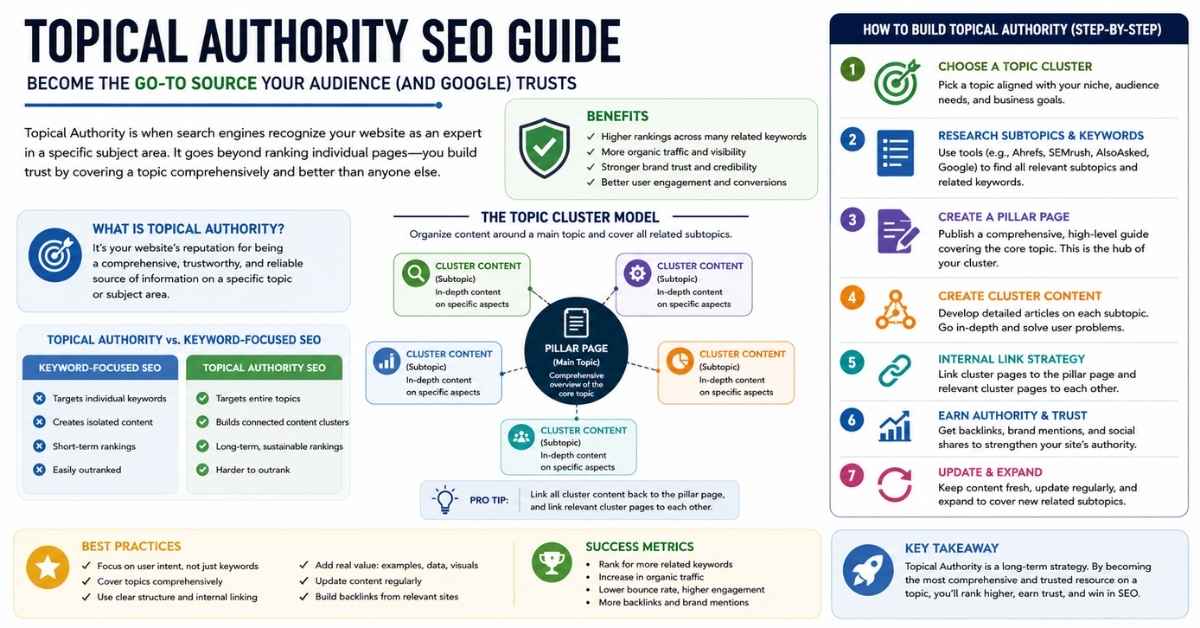
Topical authority SEO guide is the process of building deep expertise around a specific subject by publishing comprehensive, interconnected content that satisfies user intent. Instead of creating random articles, you focus on one niche, develop pillar pages, supporting topic clusters, and strong internal linking. This helps Google understand your website as a trusted source, improving topical relevance, organic rankings, and long-term search visibility.
If you've been publishing content regularly but aren't seeing consistent rankings, chances are you're missing topical authority. Today's search algorithms reward websites that demonstrate experience, expertise, authoritativeness, and trust (EEAT) while covering subjects comprehensively. Whether you run a blog, SaaS website, affiliate site, local business, or eCommerce store, building topical authority has become one of the most reliable SEO strategies for sustainable growth.
In this Topical Authority SEO Guide 2026, you'll learn how Google evaluates topical expertise, how to create topic clusters, optimize for semantic SEO, strengthen entity relationships, and build a content ecosystem that can outperform competitors in both traditional search results and AI Overviews.
Quick Answer: What Is Topical Authority in SEO?
Topical authority is Google's confidence that your website is an expert on a particular subject because it consistently publishes high-quality, well-organized, and interconnected content covering that topic in depth.
Instead of writing isolated articles, successful websites create a structured content ecosystem consisting of:
- One pillar page covering the main topic
- Multiple supporting articles answering related questions
- Strong internal linking
- Clear search intent alignment
- Rich entity optimization
- Regular content updates
For example, imagine you own a website about SEO.
Rather than publishing unrelated posts about marketing, web design, and social media, you focus on SEO by creating guides about:
- Keyword research
- Technical SEO
- Link building
- Semantic SEO
- Content optimization
- Site architecture
- Topical maps
- Internal linking
- EEAT
- Search intent
Together, these articles demonstrate subject-matter expertise, making it easier for Google to recognize your website as an authority on SEO.
Why Topical Authority Has Become Essential in 2026
SEO has changed dramatically over the past few years. Simply targeting keywords is no longer enough.
Google now evaluates how well your website understands and covers a subject instead of rewarding isolated articles.
How Google's Search Algorithms Have Evolved
Modern search is powered by several systems working together.
These include:
- Google Helpful Content System
- Semantic Search
- Google Knowledge Graph
- Entity SEO
- AI Overviews
- Natural Language Processing (NLP)
Rather than matching exact keywords, Google analyzes:
- Context
- Search intent
- Topic relationships
- Entity connections
- User satisfaction
- Content depth
This means websites demonstrating genuine expertise often outperform competitors with stronger backlink profiles but weaker topical coverage.
Why Publishing More Articles Is No Longer Enough
Many website owners believe publishing hundreds of articles automatically builds authority.
Unfortunately, that's not how Google works.
Imagine two websites.
Website A
- 400 random blog posts
- Multiple unrelated categories
- Weak internal linking
Website B
- 80 highly connected SEO articles
- Strong topical clusters
- Excellent user experience
In many cases, Website B will rank better because Google clearly understands its expertise.
Today's SEO rewards quality, organization, and relevance, not just quantity.
Topical Authority vs Domain Authority vs Topical Relevance
These terms are often confused, but they measure different aspects of SEO.
| Metric | Measures | Main Purpose |
| Topical Authority | Expertise in one subject | Improve rankings for related topics |
| Domain Authority | Overall website strength (third-party metric) | Competitive comparison |
| Topical Relevance | Relationship between page content and search intent | Better query matching |
What Makes These SEO Concepts Different?
Topical Authority
Focuses on how completely your website covers a subject.
Example:
A website publishing 100 interconnected SEO articles demonstrates stronger topical authority than a general marketing blog with scattered SEO content.
Domain Authority
Developed by third-party SEO tools, Domain Authority predicts a site's ranking potential based largely on backlinks.
Although useful, Google has repeatedly stated it does not use third-party metrics like Domain Authority as ranking factors.
Topical Relevance
This refers to how closely a page matches the user's search intent.
For example, a page about technical SEO audits is highly relevant to someone searching for "technical SEO checklist."
Which Metric Has the Biggest Impact on Rankings?
In modern SEO, topical authority and topical relevance often provide more sustainable results than chasing Domain Authority alone.
Backlinks still matter, but backlinks combined with comprehensive topic coverage create much stronger ranking signals.
Can a New Website Build Topical Authority Faster Than an Established Site?
Yes.
A new website focusing exclusively on one niche can often establish topical authority faster than a large website covering dozens of unrelated topics.
For example:
A new site dedicated entirely to SEO may outperform a general marketing blog for many SEO-related keywords because its content demonstrates stronger expertise and better semantic relationships.
How Google Understands Topical Authority
Google doesn't simply count articles.
It evaluates how well those articles connect and satisfy user needs.
Search Intent and Topic Coverage
Every search has an underlying purpose.
Examples include:
- Informational
- Commercial
- Transactional
- Navigational
To build topical authority, your content should satisfy all major search intents related to your niche.
For an SEO website, this could include:
- What is SEO?
- Keyword research tutorials
- Technical SEO guides
- Link-building strategies
- Content optimization
- Local SEO
- Semantic SEO
- AI SEO
Comprehensive topic coverage demonstrates expertise.
Entity SEO and Google's Knowledge Graph
One concept many competitors overlook is Entity SEO.
An entity is a recognizable concept, person, place, organization, or idea.
Google connects entities using the Knowledge Graph.
For example, this guide naturally relates to entities such as:
- Google Search
- EEAT
- Search Intent
- Semantic SEO
- Topic Clusters
- Pillar Pages
- Internal Linking
- Content Hubs
- AI Overviews
When these entities appear naturally within relevant contexts, Google gains a stronger understanding of your content.
Why Semantic Relationships Matter
Semantic SEO goes beyond keywords.
Instead of repeatedly using the phrase "topical authority," you naturally include related concepts such as:
- Content clusters
- Knowledge Graph
- Information architecture
- User intent
- Entity optimization
- Search quality
- Information gain
- Contextual relevance
These relationships help search engines understand the broader meaning of your content.
The Role of Internal Linking in Building Expertise
Internal links help search engines connect related pages.
Imagine publishing these articles:
- SEO Basics
- Keyword Research
- Semantic SEO
- Technical SEO
- Link Building
- On-Page SEO
When these pages link to one another naturally, they create a strong topical network.
This improves:
- Crawlability
- User experience
- Topic relationships
- Content discovery
- Authority distribution
Strong internal linking is one of the simplest ways to reinforce topical authority.
The Building Blocks of Topical Authority
Building authority doesn't happen overnight.
It starts with a clear content strategy.
Choosing One Core Topic
Many websites struggle because they try to cover everything.
Instead, choose one clear niche.
Examples include:
- SEO
- Personal Finance
- Fitness
- Pet Care
- Cybersecurity
- Gardening
A focused niche allows you to build expertise much faster.
Creating Pillar Pages
A pillar page is a comprehensive resource covering a broad topic.
Examples:
- Complete SEO Guide
- Beginner's Guide to Digital Marketing
- Ultimate WordPress SEO Guide
These pages act as central hubs for related content.
Building Supporting Topic Clusters
Each pillar page should connect to supporting articles.
For an SEO website, a cluster might include:
- How to Perform Keyword Research
- What Is Semantic SEO?
- Internal Linking Best Practices
- Technical SEO Checklist
- On-Page SEO Guide
- Link Building Strategies
- EEAT Explained
- How to Optimize for AI Overviews
Each supporting article strengthens the pillar page and reinforces topical authority.
Connecting Content Through Internal Links
Every cluster article should naturally link to:
- The pillar page
- Related cluster articles
- Supporting resources
This creates a logical content ecosystem that benefits both users and search engines.
Expanding Into Related Subtopics
Once you've covered your primary topic thoroughly, gradually expand into adjacent areas.
For an SEO website, logical expansions include:
- Content Marketing
- Conversion Rate Optimization (CRO)
- Analytics
- User Experience (UX)
- Website Performance
- Digital PR
Expanding thoughtfully helps maintain relevance while increasing your website's overall topical footprint.
By following these foundational principles, you'll create a scalable content strategy that aligns with modern search algorithms and positions your website as a trusted resource in your niche.
How to Build Topical Authority: A Step-by-Step Framework
Many website owners think topical authority happens naturally after publishing enough articles. In reality, it requires a structured strategy. The following framework can help you build topical authority faster while creating a better experience for your readers.
Step 1: Define Your Niche Clearly
The biggest mistake new websites make is trying to rank for everything.
Instead, choose one primary topic that matches your expertise and business goals.
For example:
| Website Type | Primary Topic |
| SEO Blog | Search Engine Optimization |
| Pet Website | Dog Nutrition |
| Travel Blog | Budget Travel |
| Fitness Website | Weight Loss |
| Finance Blog | Personal Finance |
A focused niche makes it easier to build topical relevance and demonstrate EEAT.
Step 2: Research Search Intent
Before writing any article, identify what users actually want.
Every keyword usually falls into one of four search intent categories:
- Informational – Learn something.
- Commercial – Compare products or services.
- Transactional – Make a purchase or take action.
- Navigational – Find a specific website or page.
Your content should satisfy the user's intent rather than simply repeating keywords.
Step 3: Create a Topical Map
A topical map is the blueprint for your content strategy.
Start with one broad topic and break it into related subtopics.
Example for an SEO website:
Main Topic: SEO
Supporting clusters:
- Keyword Research
- Technical SEO
- Link Building
- Local SEO
- On-Page SEO
- Off-Page SEO
- Semantic SEO
- Content Optimization
- AI SEO
- SEO Tools
A well-planned topical map prevents content gaps and helps search engines understand your website structure.
Step 4: Build Keyword Clusters
Instead of targeting one keyword per article, group closely related keywords together.
For example, a single article about semantic SEO can naturally include:
- semantic search
- entity SEO
- NLP optimization
- contextual relevance
- search intent
- Google Knowledge Graph
- information gain
This improves keyword coverage without creating duplicate content.
Step 5: Publish the Pillar Page First
Your pillar page acts as the central resource for the topic.
It should:
- Cover the subject comprehensively.
- Link to supporting articles.
- Answer the most common user questions.
- Serve as the foundation of your content hub.
Step 6: Publish Supporting Articles Strategically
Once the pillar page is live, publish cluster articles that explore specific topics in greater detail.
For example, after creating a pillar page about SEO, publish guides on:
- Keyword research
- Technical SEO
- Internal linking
- Topical maps
- Content pruning
- AI Overviews
Each article should support the pillar page while standing on its own.
Step 7: Strengthen Internal Linking
Internal links help users and search engines navigate your website.
Best practices include:
- Link from supporting articles to the pillar page.
- Link between closely related articles.
- Use descriptive anchor text.
- Avoid excessive or irrelevant links.
A strong internal linking structure improves crawlability and distributes authority throughout your website.
Step 8: Update Existing Content Regularly
Topical authority is not built once—it is maintained over time.
Review older articles regularly to:
- Add new statistics.
- Improve examples.
- Update screenshots.
- Expand missing sections.
- Refresh outdated information.
Fresh content signals that your website remains relevant.
Step 9: Measure Performance and Fill Content Gaps
Monitor your progress using tools such as Google Search Console, Google Analytics, Ahrefs, or Semrush.
Track:
- Organic traffic
- Keyword rankings
- Indexed pages
- Click-through rate (CTR)
- User engagement
- Internal link growth
If you notice missing subtopics, create new supporting articles to strengthen your topical coverage.
A 90-Day Topical Authority SEO Guide 2026 Roadmap
Building authority takes consistency, not shortcuts.
Weeks 1–2: Research and Planning
- Choose your niche.
- Define your audience.
- Research competitors.
- Build your topical map.
- Identify keyword clusters.
Weeks 3–4: Create Pillar Content
Write one comprehensive pillar page that covers the main topic in depth.
Make sure it includes:
- Search intent alignment
- Internal linking opportunities
- Related entities
- Frequently asked questions
Month 2: Publish Supporting Clusters
Aim to publish several high-quality supporting articles each week.
Focus on:
- Long-tail keywords
- Related entities
- User pain points
- Practical examples
Each article should link back to the pillar page.
Month 3: Optimize, Expand, and Measure
Now shift your focus to improvement.
- Add internal links.
- Refresh older content.
- Publish missing topics.
- Track rankings.
- Analyze Search Console data.
This continuous optimization helps reinforce topical authority over time.
Real Examples of Topical Authority in Different Niches
Understanding the concept is easier when you see it applied in real scenarios.
Blogging Website Example
Core Topic: SEO
Supporting content:
- Keyword Research Guide
- Technical SEO Checklist
- Link Building Strategies
- Semantic SEO Explained
- Content Optimization Tips
- Internal Linking Guide
These interconnected articles create a strong SEO content hub.
SaaS Website Example
Core Topic: Project Management
Supporting content:
- Agile Methodologies
- Team Collaboration
- Productivity Tips
- Workflow Automation
- Remote Work Best Practices
Each article supports the overall theme while addressing different user needs.
E-commerce Store Example
Core Topic: Home Coffee Brewing
Supporting content:
- Espresso Machines
- Coffee Grinders
- Brewing Methods
- Coffee Beans
- Cleaning Equipment
This approach builds expertise while attracting highly relevant traffic.
Local Business Example
Core Topic: Plumbing Services
Supporting content:
- Emergency Plumbing
- Water Heater Repairs
- Leak Detection
- Drain Cleaning
- Bathroom Remodeling
Local businesses can use topical authority to improve both local SEO and organic visibility.
Affiliate Website Example
Core Topic: Outdoor Camping
Supporting content:
- Camping Tents
- Sleeping Bags
- Hiking Backpacks
- Portable Stoves
- Camping Checklists
A focused content strategy often performs better than publishing unrelated product reviews.
How Many Articles Do You Need to Build Topical Authority?
One of the most common questions is:
"How many articles are enough?"
The answer depends on your niche and competition.
Does Every Topic Require Hundreds of Articles?
No.
A smaller niche may only require 30–50 comprehensive articles.
Highly competitive industries may need hundreds of well-connected resources.
The goal isn't to publish the most articles—it is to provide the most complete coverage of your chosen topic.
Quality vs Quantity
Publishing 20 exceptional articles that thoroughly answer user questions is often more valuable than publishing 200 thin pages.
Prioritize:
- Original insights
- Comprehensive explanations
- Practical examples
- Updated information
- Clear organization
When to Expand Into Related Topics
Only expand after you have covered your primary topic thoroughly.
For example, an SEO website might later publish content about:
- Digital Marketing
- User Experience (UX)
- Conversion Rate Optimization (CRO)
- Analytics
Expanding gradually helps maintain relevance while increasing your website's authority.
Common Mistakes That Prevent Topical Authority
Even experienced website owners make mistakes that slow their growth.
Publishing Unrelated Content
Avoid chasing every trending keyword.
Stick to topics that support your primary niche.
Weak Internal Linking
Without internal links, your articles become isolated pages instead of a connected knowledge base.
Keyword Cannibalization
Creating multiple articles targeting the same search intent confuses search engines and weakens rankings.
Ignoring Search Intent
Ranking isn't just about keywords.
Your content must solve the user's problem better than competing pages.
Not Updating Older Articles
Outdated content gradually loses value.
Regular updates help maintain rankings and demonstrate ongoing expertise.
Relying Only on AI-Generated Content
AI can speed up content creation, but it should never replace human expertise.
Add:
- Personal experience
- Real examples
- Original research
- Practical insights
These elements strengthen EEAT and improve user trust.
Does Topical Authority Replace Backlinks?
This is another common misconception.
Can Strong Topic Coverage Reduce the Need for Backlinks?
Building topical authority can improve rankings, especially for low- and medium-competition keywords.
However, backlinks remain an important ranking signal.
Why Topical Authority and Link Building Work Better Together
Think of them as complementary strategies.
- Topical authority demonstrates expertise.
- Backlinks demonstrate external trust.
When combined, they create a stronger foundation for long-term SEO success.
Building Trust Without Chasing Thousands of Links
Instead of obsessing over backlink quantity, focus on:
- Publishing genuinely helpful content.
- Covering topics comprehensively.
- Creating logical internal links.
- Building a recognizable brand.
These practices naturally attract higher-quality backlinks over time.
How to Measure Topical Authority
Building topical authority is only half the job. The other half is measuring whether your strategy is actually improving your website's visibility.
Unlike Domain Authority, Google doesn't provide a "Topical Authority Score." Instead, you need to evaluate several performance indicators together.
Organic Traffic Growth
One of the strongest signs that your topical authority is improving is a steady increase in organic traffic.
Rather than focusing on one article, monitor how your entire content cluster performs over time.
Keyword Visibility
Track:
- Total ranking keywords
- Top 3 rankings
- Top 10 rankings
- Long-tail keyword growth
- Featured snippets
If more related keywords begin ranking naturally, Google is likely recognizing your expertise on the topic.
Topical Coverage
Ask yourself:
- Have I covered every important subtopic?
- Are there unanswered user questions?
- Are competitors discussing topics I've missed?
Performing a quarterly content gap analysis helps you identify opportunities to strengthen your authority.
Search Console Performance
Google Search Console provides valuable insights, including:
- Clicks
- Impressions
- Average position
- Click-through rate (CTR)
- Indexing status
Watch for gradual improvements across your topic cluster rather than individual pages.
Internal Link Health
Review your internal linking regularly.
Every supporting article should connect naturally to:
- Pillar pages
- Related cluster articles
- Helpful resources
A strong internal linking structure improves both crawlability and user experience.
User Engagement Signals
While Google doesn't confirm every engagement metric as a ranking factor, positive user behavior often reflects high-quality content.
Monitor:
- Average engagement time
- Scroll depth
- Returning visitors
- Pages per session
- Bounce trends
If users spend more time exploring your content hub, it's a good sign your topical strategy is working.
LEARN MORE: Backlinks not showing up in Ahrefs
Advanced Strategies Most SEO Guides Ignore
Once you've established a solid content foundation, these advanced techniques can help you stay ahead of competitors.
Entity Optimization
Google understands topics through entities, not just keywords.
Instead of repeating the same phrase, naturally incorporate related entities.
For an SEO website, examples include:
- Google Search
- Google Search Central
- EEAT
- Semantic SEO
- Knowledge Graph
- Search Intent
- Internal Linking
- Topic Clusters
- Content Hubs
- AI Overviews
This strengthens contextual relevance and helps search engines understand your expertise.
Information Gain
Publishing content that simply repeats existing information is unlikely to stand out.
Aim to add information gain by including:
- Original frameworks
- First-hand experience
- Case studies
- Industry observations
- Updated statistics
- Practical workflows
Giving readers something they can't easily find elsewhere makes your content more valuable.
Content Pruning
Not every article deserves to stay on your website forever.
Regularly review your content and:
- Merge overlapping articles.
- Remove outdated pages.
- Redirect thin content.
- Update valuable resources.
Content pruning improves overall quality and prevents keyword cannibalization.
Content Refresh Strategy
Refreshing existing content is often faster and more effective than publishing new articles.
Update:
- Statistics
- Screenshots
- Examples
- Internal links
- FAQs
- Search intent alignment
A refreshed article can regain lost rankings and strengthen your topical authority.
Building Content Hubs
Instead of treating articles as standalone pieces, organize them into content hubs.
A content hub includes:
- One comprehensive pillar page
- Multiple supporting cluster articles
- Logical internal linking
- Clear navigation
This structure benefits both users and search engines.
Optimizing for AI Overviews
As AI-powered search experiences continue to evolve, your content should be easy for AI systems to understand.
Focus on:
- Clear headings
- Direct answers
- Well-structured paragraphs
- Entity-rich content
- Accurate information
- Helpful examples
These practices increase your chances of being referenced in AI Overviews and other AI-driven search features.
Future-Proofing Your SEO Strategy
SEO will continue to evolve, but certain principles remain constant:
- Help users first.
- Cover topics comprehensively.
- Demonstrate expertise.
- Keep content updated.
- Build trust over time.
Websites that consistently follow these principles are more likely to remain competitive regardless of algorithm changes.
Practical Checklist Before You Publish Every Article
Before clicking "Publish," review this checklist.
Search Intent Check
- Does the article answer the user's primary question?
- Is the intent informational, commercial, or transactional?
Entity Coverage Check
- Have you naturally included relevant entities?
- Are related concepts explained clearly?
Internal Linking Check
- Does the article link to the pillar page?
- Are supporting articles connected?
EEAT Review
- Have you demonstrated expertise?
- Are examples practical and accurate?
- Is the information trustworthy and up to date?
Content Freshness Review
- Have you checked facts and statistics?
- Are screenshots and examples current?
- Does the article reflect recent SEO developments?
Following this checklist before every publication helps maintain quality across your entire website.
Topical Authority SEO Guide 2025 vs Topical Authority SEO Guide 2026
The core principles of topical authority remain the same, but search has evolved.
| Topical Authority SEO Guide 2025 | Topical Authority SEO Guide 2026 |
| Focused on topic clusters | Focuses on topic clusters plus entities |
| Emphasized internal linking | Strong emphasis on semantic relationships |
| Targeted search intent | Optimizes for AI Overviews and conversational search |
| Relied heavily on keyword clusters | Prioritizes comprehensive topic coverage and information gain |
| Basic EEAT implementation | Stronger focus on demonstrated expertise and trust |
While the Topical Authority SEO Guide 2025 introduced many websites to content clusters, the Topical Authority SEO Guide 2026 goes further by integrating entity SEO, semantic optimization, and user-focused content strategies.
Frequently Asked Questions
What is topical authority in SEO?
Topical authority is Google's confidence that your website is an expert on a specific subject because it provides comprehensive, high-quality, and interconnected content that satisfies user intent.
How long does it take to build topical authority?
Most websites begin seeing measurable improvements within three to six months, depending on competition, content quality, publishing consistency, and internal linking.
How many articles are needed?
There is no universal number. Some niches may require only a few dozen comprehensive articles, while highly competitive industries may need significantly more. Focus on complete topic coverage, not article count.
Can a new website build topical authority?
Yes. A new website that focuses on one niche and publishes well-structured, high-quality content can establish topical authority faster than a broad website covering unrelated subjects.
Does topical authority improve Google rankings?
Yes. Strong topical authority helps Google understand your expertise, which can improve rankings, increase organic traffic, and expand keyword visibility over time.
Is topical authority more important than backlinks?
Both are valuable. Topical authority demonstrates expertise, while backlinks demonstrate external trust. Together, they create a stronger SEO strategy than relying on either factor alone.
What is the difference between topical authority and domain authority?
Topical authority measures expertise within a specific subject, whereas Domain Authority is a third-party metric that estimates a website's overall ranking potential.
How often should I update topic clusters?
Review important content every six to twelve months, or sooner if there are significant industry changes, algorithm updates, or new user questions.
Can AI-generated content help build topical authority?
AI can assist with research and drafting, but lasting topical authority comes from adding human expertise, practical experience, unique insights, and original value.
Final Thoughts: Build Trust Before You Chase Rankings
A successful Topical Authority SEO Guide is not about publishing the most articles or targeting every keyword. It is about creating a well-organized content ecosystem that genuinely helps your audience.
Start with a clearly defined niche, build pillar pages, expand with topic clusters, strengthen internal linking, and regularly update your content. As your website grows, focus on semantic SEO, entity optimization, and delivering information that demonstrates real expertise rather than simply repeating what already exists online.
Remember, topical authority is earned through consistency. Every helpful article, every relevant internal link, and every content update strengthens your reputation with both users and search engines. By prioritizing quality, completeness, and trust, you'll build a website that is better positioned to rank in traditional search results and emerging AI-powered search experiences.
A long-term commitment to helpful, authoritative content is what transforms an ordinary website into a trusted resource that readers—and Google—return to again and again.