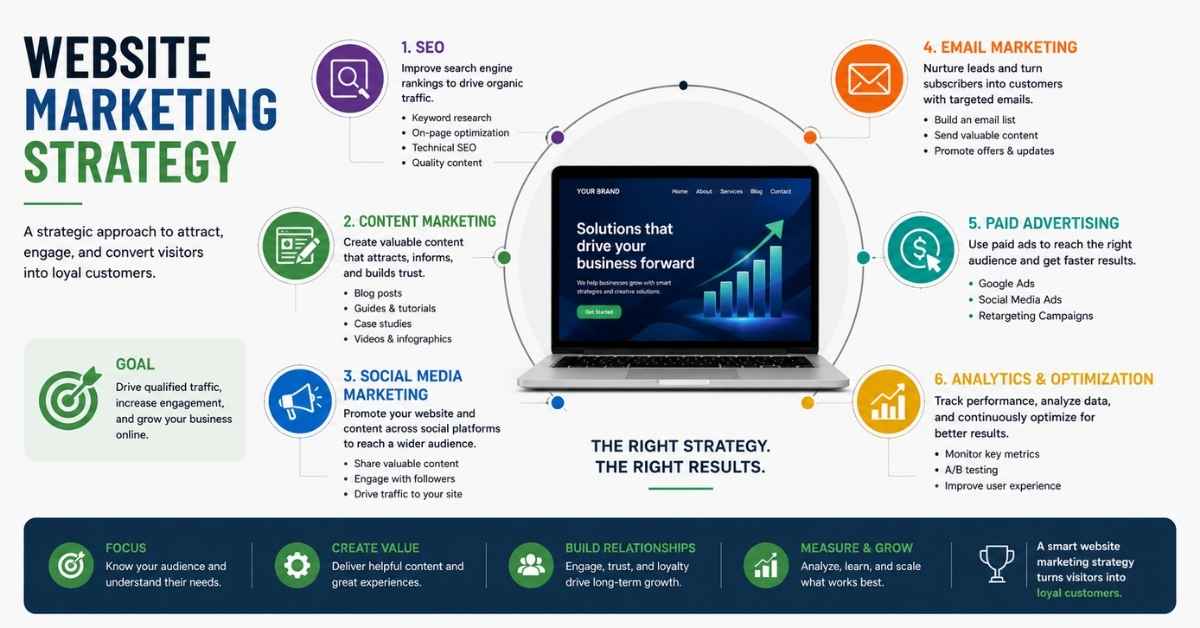
Website marketing strategy is a structured plan that helps businesses attract the right audience, increase website traffic, generate qualified leads, and convert visitors into loyal customers.
Instead of relying on random marketing tactics, an effective website marketing strategy combines SEO, content marketing, email marketing, social media marketing, PPC advertising, conversion rate optimization (CRO), and analytics into one unified system.
Whether you're a small business, startup, blogger, or established brand, the right strategy transforms your website into a powerful marketing asset that delivers long-term growth.
Website Marketing Strategy: What It Is and Why Every Business Needs One
A website marketing strategy is more than promoting your website on search engines or social media. It is a complete digital marketing strategy designed to help people discover your business, engage with your content, trust your brand, and take meaningful actions.
Without a strategy, businesses often invest time and money into isolated marketing activities that produce inconsistent results. A well-planned website marketing plan ensures every marketing channel supports the same business objectives.
A successful strategy helps you:
- Increase organic traffic
- Generate high-quality leads
- Improve search visibility
- Strengthen brand awareness
- Increase conversion rates
- Build long-term customer relationships
- Maximize marketing ROI
The Five Pillars of a Successful Website Marketing Strategy
Every effective online marketing strategy is built on five essential pillars:
- Clear business goals
- Audience-focused content
- Strong SEO foundation
- Multi-channel promotion
- Continuous optimization
When these elements work together, your website becomes a reliable source of traffic and revenue.
Set Clear Goals Before You Market Your Website
Many businesses launch marketing campaigns without defining success. This often leads to wasted budgets and disappointing results.
Define Business Objectives
Before creating campaigns, identify your primary goal.
Examples include:
- Increasing online sales
- Growing email subscribers
- Generating qualified leads
- Improving local visibility
- Building industry authority
Clear objectives help prioritize your marketing efforts.
Understand Your Ideal Audience
Knowing your audience is essential for every website promotion strategy.
Create detailed buyer personas by understanding:
- Age
- Interests
- Problems
- Buying behavior
- Search intent
- Preferred communication channels
The better you understand your audience, the easier it becomes to create content that converts.
Analyze Your Competitors
Competitor research reveals valuable opportunities.
Study:
- Their content strategy
- Target keywords
- Content gaps
- User experience
- Calls to action
- Internal linking
- Customer engagement
Rather than copying competitors, identify opportunities they have overlooked.
Goal-Setting Checklist
Before moving forward, confirm that you have:
- Defined measurable goals
- Identified your audience
- Completed keyword research
- Reviewed competitors
- Selected performance indicators
Build a Website That Converts Visitors Into Customers
Driving traffic is only half the challenge. Your website must encourage visitors to take action.
Improve User Experience (UX)
A clean layout, intuitive navigation, and easy-to-read content improve engagement.
Visitors should quickly understand:
- What your business offers
- Why they should trust you
- What action to take next
Optimize Website Speed
Fast-loading websites improve both user satisfaction and SEO.
Compress images, enable caching, and remove unnecessary scripts to improve performance.
Prioritize Mobile-First Design
Most visitors browse using smartphones. Responsive design ensures a consistent experience across devices.
Simplify Navigation
Organize menus logically so users can easily find important pages.
Write Strong Calls to Action
Effective calls to action (CTAs) encourage users to:
- Contact your business
- Download resources
- Subscribe to newsletters
- Request quotes
- Purchase products
Keep your CTAs clear, visible, and action-oriented.
Build Trust With Visitors
People buy from businesses they trust.
Increase credibility by adding:
- Customer testimonials
- Verified reviews
- Security badges
- Clear contact information
- Privacy policy
- Professional About page
These trust signals reduce hesitation and improve conversions.
The GROW Framework for Building a Website Marketing Strategy
Instead of treating marketing channels separately, use the GROW Framework to create a sustainable growth system.
G – Goals
Start with measurable objectives.
Examples include:
- Increase organic traffic by 30%
- Generate 100 monthly leads
- Improve conversion rate
- Increase repeat customers
R – Research
Successful marketing begins with research.
Focus on:
- Keyword research
- Audience analysis
- Competitor evaluation
- Customer journey mapping
- Search intent
This information guides every marketing decision.
O – Optimize
Optimization includes multiple areas:
- Technical SEO
- Internal linking
- Landing pages
- Website speed
- Content optimization
- Mobile usability
- User experience
Continuous optimization improves both rankings and conversions.
W – Win
After building a strong foundation, scale your efforts through:
- Email marketing
- Content marketing
- Social media marketing
- PPC advertising
- Marketing automation
- Performance analytics
This creates a complete website growth strategy rather than isolated campaigns.
The Marketing Channels That Work Best Together
No single marketing channel guarantees success. The strongest results come from combining multiple channels.
Search Engine Optimization (SEO)
SEO increases long-term visibility by helping your pages rank for relevant searches.
Focus on:
- Keyword research
- Technical SEO
- High-quality content
- Internal linking
- Topical authority
- EEAT principles
Content Marketing
Helpful content attracts visitors while building authority.
Publish:
- Blog articles
- Guides
- Tutorials
- Case studies
- Industry insights
- FAQs
Every piece of content should solve a specific problem.
Email Marketing
Email remains one of the highest-ROI marketing channels.
Use email to:
- Welcome subscribers
- Share educational content
- Promote products
- Recover abandoned carts
- Build customer loyalty
Social Media Marketing
Social platforms help distribute content, engage audiences, and strengthen brand recognition.
Choose platforms where your audience is already active instead of trying to be everywhere.
Pay-Per-Click (PPC) Advertising
PPC delivers immediate visibility while your SEO efforts grow.
Well-managed campaigns can generate qualified traffic quickly.
Digital PR
Digital PR builds brand authority through media mentions, interviews, expert contributions, and quality backlinks.
| Marketing Channel | Cost | Speed | Long-Term ROI | Best Use Case |
| SEO | Medium | Slow | Excellent | Sustainable traffic |
| Content Marketing | Medium | Moderate | Excellent | Authority building |
| Email Marketing | Low | Fast | Excellent | Customer retention |
| PPC | High | Immediate | Moderate | Quick lead generation |
| Social Media | Low | Moderate | Good | Brand awareness |
| Digital PR | Medium | Moderate | Excellent | Trust and credibility |
How to Create Content That Attracts and Converts
Content is the foundation of every successful website marketing strategy. Instead of publishing articles randomly, create content that aligns with your audience's needs and business goals.
Match Search Intent
Every page should answer a specific question or solve a particular problem. Whether users are looking for information, comparing products, or ready to make a purchase, your content should satisfy that intent completely.
Build Topical Authority
Rather than writing about unrelated subjects, focus on becoming an expert in your niche. Publish interconnected articles that cover a topic from multiple angles using internal linking and content clusters. This approach strengthens your SEO and helps search engines understand your expertise.
Publish Original Insights
Readers trust businesses that share first-hand experience, practical tips, and unique perspectives. Avoid rewriting competitor content. Instead, include examples, lessons learned, and actionable advice that readers can't easily find elsewhere.
Use EEAT to Build Trust
Google values content that demonstrates Experience, Expertise, Authoritativeness, and Trustworthiness (EEAT). Strengthen these signals by:
- Citing reliable sources
- Sharing real-world examples
- Updating outdated information
- Writing with transparency
- Maintaining a professional author profile
Helpful content builds lasting authority, while promotional content quickly loses reader trust.
Turn Website Visitors Into Qualified Leads
Traffic alone doesn't grow a business. Your website should guide visitors through a clear marketing funnel that turns interest into action.
Build High-Converting Landing Pages
Every campaign should direct visitors to a focused landing page with:
- A clear headline
- A compelling value proposition
- Strong calls to action
- Customer testimonials
- Minimal distractions
Offer Valuable Lead Magnets
Encourage visitors to share their contact information by offering resources such as:
- Free guides
- Checklists
- Templates
- eBooks
- Webinars
Optimize Email Capture Forms
Keep forms simple. Ask only for essential information to reduce friction and improve conversions.
Use Marketing Automation
Automation helps nurture leads without manual effort. Create email sequences that educate, answer questions, and guide subscribers toward a purchase.
Simple Lead Funnel
Visitor → Valuable Content → Email Signup → Follow-Up Emails → Qualified Lead → Customer → Loyal Customer
Website Marketing Strategies for Different Business Types
Every business has different marketing priorities. Customize your strategy based on your goals and audience.
| Business Type | Recommended Strategy | Primary Goal |
| Small Business | Local SEO, content marketing, email | Lead generation |
| Local Business | Google Business Profile, reviews, local SEO | Local visibility |
| E-commerce | Product SEO, PPC, email automation | Online sales |
| SaaS | Educational content, webinars, SEO | Product trials |
| B2B | Thought leadership, LinkedIn, email | Qualified leads |
| Bloggers | SEO, topical authority, affiliate content | Organic traffic |
Choosing the right channels saves time and improves marketing efficiency.
Measure What Matters: KPIs That Drive Growth
Tracking performance helps you understand which marketing efforts generate results.
Monitor these Key Performance Indicators (KPIs):
- Organic traffic
- Conversion rate
- Cost per lead
- Customer acquisition cost
- Return on investment (ROI)
- Customer lifetime value
- Bounce rate
- Average session duration
- Email open rate
- Click-through rate
Review these metrics regularly using Google Analytics and Google Search Console to identify opportunities for improvement.
LEARN MORE: Dofollow vs Nofollow Backlinks
Common Website Marketing Mistakes That Slow Growth
Avoiding common mistakes can save significant time and resources.
Ignoring SEO
Without proper technical SEO, keyword research, and content optimization, even excellent websites struggle to attract visitors.
Publishing Thin Content
Short, repetitive, or low-value content rarely performs well. Focus on solving problems with detailed, helpful information.
Weak Calls to Action
Every important page should encourage users to take the next step. Clear CTAs improve conversions.
Chasing Every Marketing Trend
Not every trend fits your business. Build a consistent strategy instead of constantly changing direction.
Not Tracking Results
Marketing without analytics is guesswork. Measure performance before making major decisions.
Focusing Only on Traffic
High traffic means little if visitors never become customers. Prioritize lead generation, conversion rate optimization (CRO), and customer retention.
| Mistake | Better Approach |
| Targeting every channel | Focus on channels your audience uses |
| Ignoring user experience | Improve navigation and website speed |
| Publishing without research | Create content based on search intent |
| Measuring traffic only | Track conversions and ROI |
| Updating content rarely | Refresh important pages regularly |
Your 90-Day Website Marketing Action Plan
Days 1–30
- Perform a website audit
- Set measurable goals
- Install analytics tools
- Conduct keyword research
- Fix technical SEO issues
- Improve page speed
Days 31–60
- Publish optimized content
- Build topic clusters
- Improve internal linking
- Launch email marketing campaigns
- Optimize landing pages
Days 61–90
- Build high-quality backlinks
- Test PPC advertising
- Improve conversion rates with A/B testing
- Review KPIs
- Update underperforming pages
- Expand successful campaigns
Following this roadmap creates consistent progress instead of scattered marketing efforts.
Expert Tips for Sustainable Website Growth
Long-term growth comes from consistency rather than shortcuts.
Keep these principles in mind:
- Update existing content before constantly creating new articles.
- Diversify traffic sources instead of relying solely on search engines.
- Build relationships through digital PR and industry partnerships.
- Focus on audience needs before search engine algorithms.
- Continue testing headlines, landing pages, and CTAs.
- Adapt your strategy to evolving search behaviors, including AI-powered search experiences.
Businesses that consistently improve their websites often outperform competitors over time.
Frequently Asked Questions
What is a website marketing strategy?
A website marketing strategy is a structured plan that combines SEO, content marketing, email marketing, social media, paid advertising, and conversion optimization to increase traffic, generate leads, and grow revenue.
How do I create a website marketing strategy?
Start by defining goals, understanding your audience, researching competitors, optimizing your website, selecting the right marketing channels, and measuring performance using KPIs.
Which marketing channel delivers the best ROI?
For many businesses, SEO and email marketing deliver the strongest long-term return because they generate sustainable traffic and strengthen customer relationships.
How long does SEO take to produce results?
SEO is a long-term strategy. Meaningful improvements often become visible within several months, depending on competition, website quality, and consistency.
Should I invest in SEO or PPC first?
If you need immediate traffic, PPC can provide quick visibility. If your goal is sustainable growth, prioritize SEO while using PPC strategically where appropriate.
How much should I budget for website marketing?
Budgets vary depending on business size and goals. Focus first on activities that align with your objectives and provide measurable returns before expanding into additional channels.
Final Thoughts
A successful website marketing strategy is not about following every marketing trend or investing heavily in every channel. It's about creating a system where SEO, content marketing, email marketing, social media marketing, PPC advertising, digital PR, and conversion rate optimization work together to support your business goals.
By understanding your audience, publishing helpful content, optimizing your website for both users and search engines, and tracking meaningful performance metrics, you can build a website growth strategy that consistently generates organic traffic, qualified leads, and long-term revenue.
The businesses that achieve lasting success are those that treat their website as more than an online brochure. They view it as their most valuable digital marketing asset—one that continually evolves, builds trust, and delivers measurable results year after year.